 AJ
AJ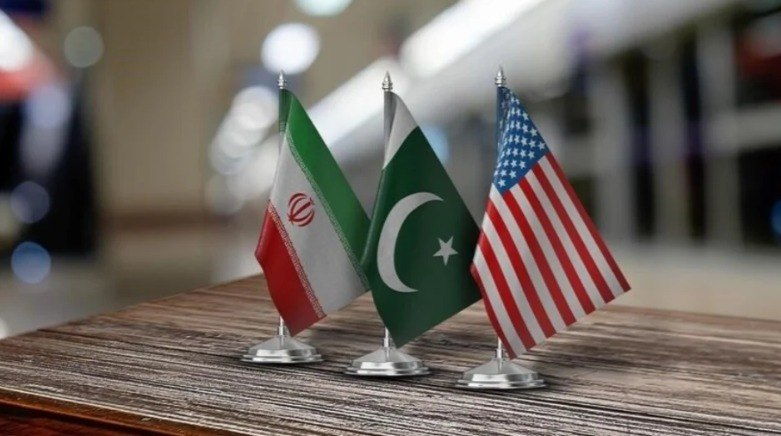
Strait of Hormuz:

The Closure of the Strait of Hormuz became a major source of frustration for President Donald Trump, who was surprised at how easy it was to shut it down: “A guy with a drone can close it,” he said, reported AlHaq News.
UK Foreign Secretary Yvette Cooper said she held talks with Pakistan’s Foreign Minister Ishaq Dar on extending the Iran-US ceasefire and reopening the shipping routes through the Strait of Hormuz.
Medhi Tabatabaei, the Iranian President’s aide for Public Relations, warned that the recent development brought about by the US had reshaped the strategic reality of the Strait of Hormuz: “A new order has been established in the Strait of Hormuz,” he said, further warning: “If it is repeated, new regimes will be imposed over other waterways,” as Tabatabaei explained the situation followed ‘Iran’s enemies’ commitment of grave mistakses and great crimes.
Ahmad Vahidi, the commander of the IRGC, said they have taken full control of the Iranian military and negotiation process in recent days, which led to the closing of the Strait of Hormuz, according to the Institute for the Study of War, who noted that during negotiations in Islamabad last week, IRGC Generals joined the Iranian negotiating team for an update on the diplomatic process, and have taken a much more in-depth approach diplomatically than ever before.
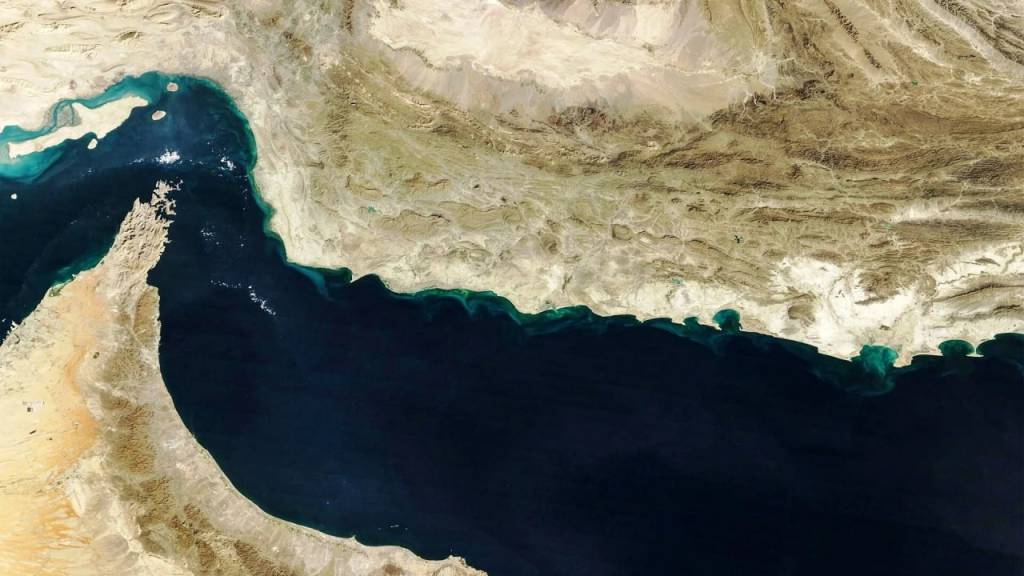
The IRGC confirmed that because America hadn’t lifted the naval blockade of Iranian vessels, the Strait of Hormuz would remain closed until such time the blockade has been lifted, warning that no vessel should move from its anchorage in the Persian Gulf and the Sea of Oman, or they will be considered to be cooperating with the ‘enemy’ and the violating vessel will be targeted, adding that the statements of the US President regarding the Strait of Hormuz and the Persian Gulf had no credibility, and ships should follow updates only from the official source of Iran’s Naval Forces.
On Sunday morning, data from the Marine Traffic website showed two gas carriers returning to the waters of the Gulf after attempting to cross the Strait of Hormuz, reported Al Jazeera.
Two ships flying the flags of Botswana and Angola were also planning to cross the Strait, but there was timely intervention from the Iranian armed forces which forced them to change their course and retreat, reported Tasnim News Agency.
Another ship that belonged to the French company CMA CGM reported it received warning shots from the Iranian Navy after it moved through the Strait of Hormuz.
US forces are currently using manned and unmanned means to remove mines from the Strait of Hormuz, reported the WSJ and Al Jazeera, citing US officials, stating that Iran had planted mines in the Strait of Hormuz, but the extent of the threat was unclear.
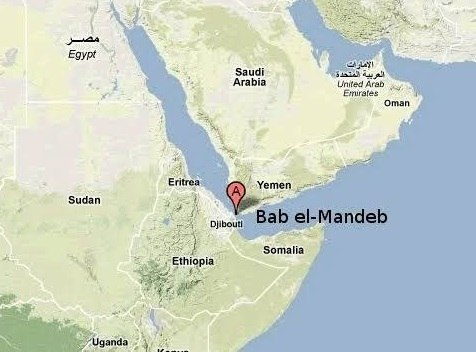
In addition to the Strait of Hormuz, the advisor to the Iranian Supreme Leader reported the security of the Bab al-Mandab Strait was now in the hands of Ansar Allah, (Houthis), and the security of the Strait of Hormuz along with the Strait of Malacca was protected thanks to the strength of the strategic partners, adding that the Paris meeting on the Strait of Hormuz announced on Saturday was a ridiculous proposal, but they appreciated Spain’s independent and rational positions, reported Quds and Al-Mayadeen.
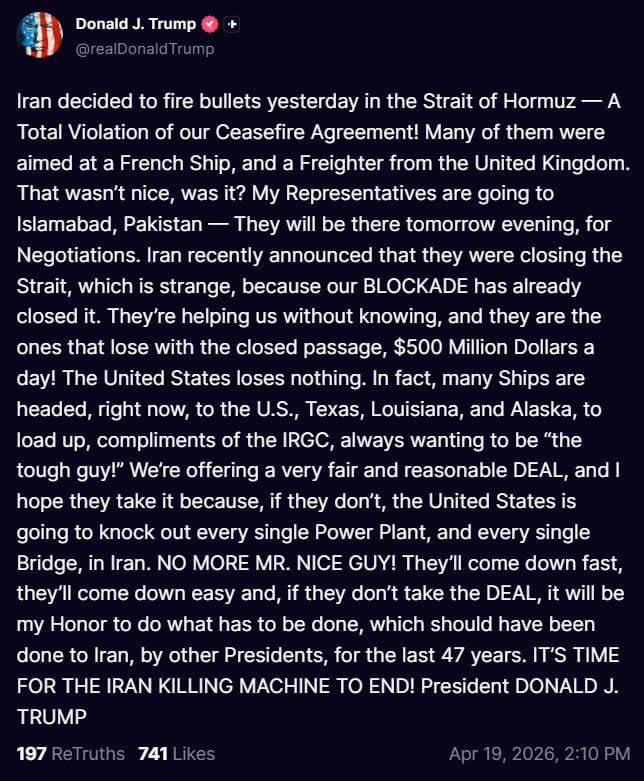
President Trump reacted to Iran’s blockade on Sunday morning stating that its strange Iran has blocked the Strait of Hormuz, because the US have already closed it, adding that the US were offering a very fair and reasonable deal, which they were hoping Iran was going to take because, if they don’t, the United States is going to knock out every single power plant, and every single bridge, in Iran.
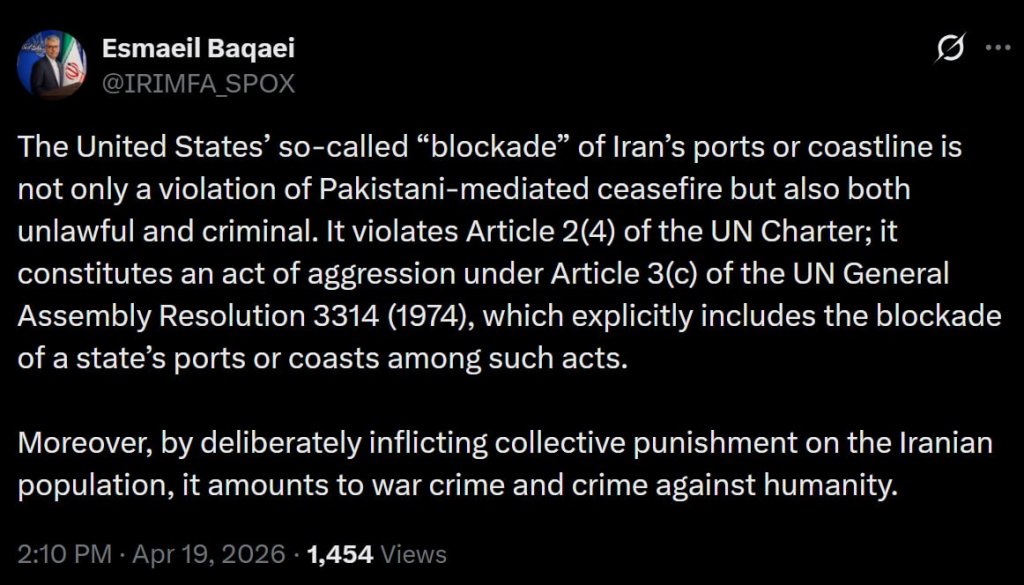
Iranian Foreign Ministry spokesperson Esmaeil Baghaei said the United States’ so-called blockade of Iran’s ports or coastline wasn’t only a violation of Pakistani-mediated ceasefire efforts but also both unlawful and criminal, while deliberately inflicting collective punishment on the Iranian population amounted to war crimes and crimes against humanity.
The US Navy announced it will begin to inspect any ships heading for China as part of the fight against Iranian oil shipments, said US Ambassador to the UN Mike Waltz.
No tankers have crossed the Strait of Hormuz on Sunday, reported the IRGC Navy, who confirmed they did turn around two tankers carrying liquid petroleum gas that were heading out of the Persian Gulf.
Mehr News broke the story that an American ship had fired on an Iranian commercial ship that had travelled from China to Iran through the Gulf of Oman, but noted due to the timely presence and rapid response of the IRGC in support of the Iranian ship, they US forces had to retreat the area.
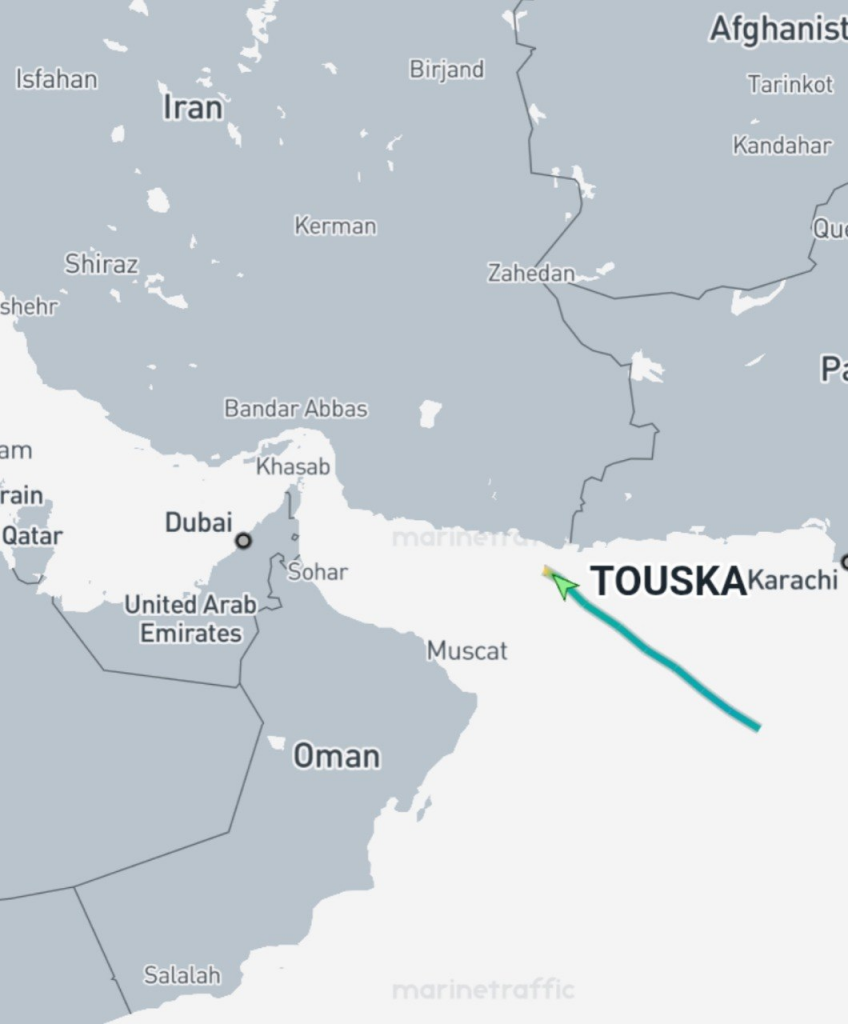
President Trump confirmed the Mehr News report, but claimed the US had seized the vessel, marking the first Iranian vessel taken under US control in the current ongoing naval blockade: “Today, an Iranian-flagged cargo ship named TOUSKA, nearly 900 feet long and weighing almost as much as an aircraft carrier, tried to get past our Naval Blockade, and it did not go well for them. The US Navy Guided Missile Destroyer USS Spruance intercepted the TOUSKA in the Gulf of Oman, gave them fair warning to stop, and after the Iranian crew refused to listen, our Navy stopped them right in their tracks by blowing an hole in their engine room,” adding that Marines had custody of the vessel and searching it to see what was on board.
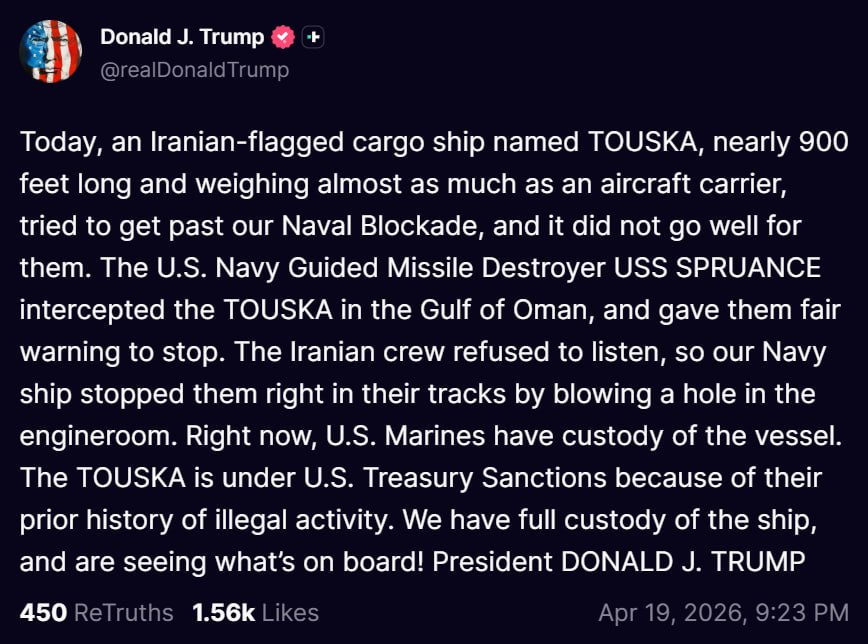
The Armed forces of Iran said they would respond soon to the ‘maritime robbery’ of the United States, reported Iran’s Central Military Command, as Central Command released footage of the US Navy firing warning shots at the Touska in the Gulf of Oman which was later seized by the United States.
US Marines departed the amphibious USS Tripoli (LHA 7) by helicopter and transited over the Arabian Sea to board and seize the M/V Touska, after which the Marines rapelled onto the Iranian vessel on April 20, following the guided missile destroyer USS Spruance (DDG111) disabling Touska’s propulsion system when the commercial ship failed to comply with repeated warnings form the US forces for over a six-hour period, reported Central Command.
Following the attacks, the Islamic Defence Forces attacked the USS Destroyer the USS Liberty in retaliation for the seizure of the Iranian oil tanker, launching drones at the ship and forcing it to retreat to safety.
Negotiation News:
Guests in major hotels in Islamabad have been asked to leave by noon Sunday, as government security forces took control of properties, as alsaa_plus noted that some progress must have been made towards hosting a second round of US-Iran talks.
Pakistan were beginning to lose optimism about holding another round of talks between the US and Iran, reported Al Jazeera and The War Reporter, stating it was because Tehran refused to compromise on uranium enrichment and broader nuclear issues.
CNN quoted a White House official who said Vance would attend the next round of talks with Iran in Pakistan, and in response to the conflicting statements about the American delegation, the White House official said ‘the situation has changed,’ reported War Spectators, which came after Trump told reporters Vance wouldn’t travel to Islamabad because of ‘security issues.’
Three US Airforce C-17 planes landed at Pakistan Air Force Base Nur Khan earlier on Sunday ahead of new talks, reported local IROP News, stating they were carrying VPOTUS security motorcade and equipment, which further indicated Vance was going to visit Islamabad again for negotiations.
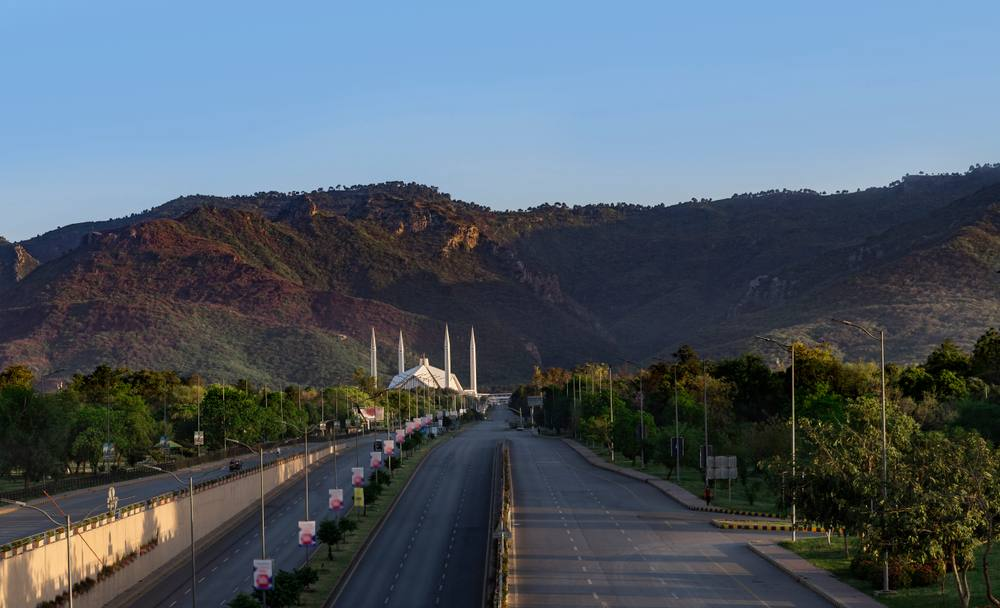
Capital Police in Pakistan confirmed that the Red Zone in Islamabad had been sealed off for traffic ahead of the possible second round of talks coming up this week.
Some Pakistani sources believe that Vance’s absence from Islamabad could be linked to the possibility of President Trump travelling to the Pakistani capital in the event an agreement is reached, noting that protocol wouldn’t allow both to be present, and Trump had said earlier he might travel to Islamabad himself in case an agreement is signed with Tehran.
There is an high likelihood that the Iranian delegation would arrive in Pakistan on Tuesday for talks with the US, Iranian sources familiar with the negotiations told CNN, stating the sources expected the same team as the last round, and said they expect that there will be a symbolic joint announcement of an extension of the ceasefire which would allow talks to progress.
US Ambassador to the UN Mike Waltz told ABC News that Vice President JD Vance would lead the delegation for the talks with Iran in Islamabad, stating that everything was on the table and President Trump had made it clear he was prepared to escalate and de-escalate the conflict, adding that the US had a long history of taking down bridges, power plants.
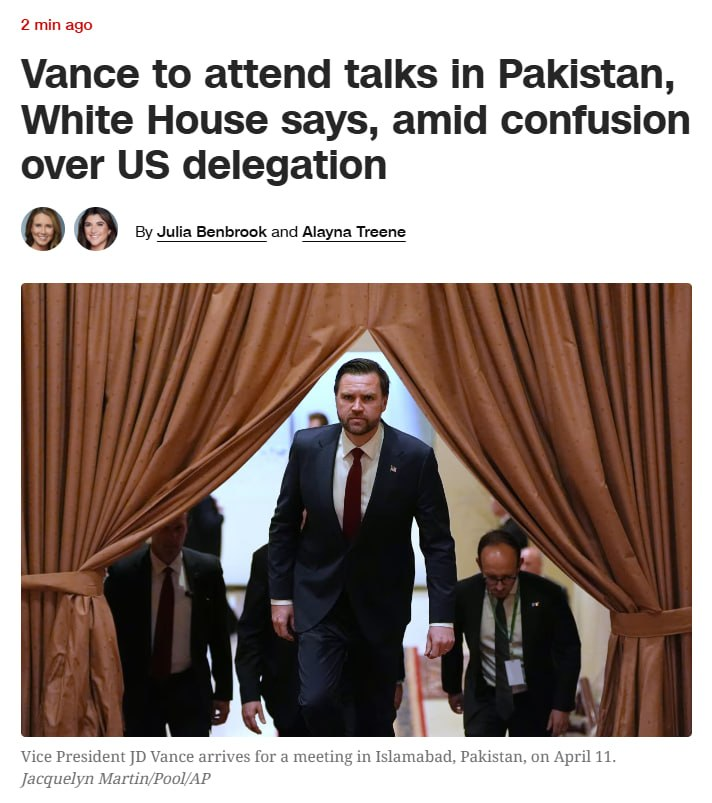
A US official told Axios that JD Vance would also be leading the negotiations, while CNN reported they were told by the White House that Vance would join Steve Witkoff and Jared Kushner.
Tasnim News reported that Iran had decided not to send a delegation to Islamabad for talks and has made clear that no negotiations would take place as long as the blockade remained in effect, stating that indirect communications between Tehran and Washington was still ongoing through Pakistani intermediaries after the first round of talks collapsed, but Iranian officials insist the blockade implemented by President Trump must be lifted before any negotiations can proceed.
European allies fear the US negotiating team are pushing for a swift deal with Iran that could entrench rather than resolve deeper problems, with French, British, and German diplomats reporting they’ve been sidelined, while also saying a deep mistrust and sharply different negotiating styles raised the risk of a fragile framework neither side could sustain politically, Reuters reported.
IRNA reported on Sunday evening that Iran has denied reports of a second round of negotiations, stating excessive demands, unreasonable and unrealistic positions, constant contradictions, the ongoing naval blockade, and threatening rhetoric have prevented progress: “In these circumstances, no clear outlook for productive talks is conceivable,” the report added, describing the US announcements as a media game and a ‘blame game’ to pressure Iran.
President Trump told Israeli Channel 12 that he felt good about a potential deal with Iran: “The concept of the deal is already closed – I think we have a very good chance of completing it,” he said.
Talks are reaching a decisive stage, reported Kan News, but sources said communication difficulties with Iran’s new Supreme Leader Mojtaba Khamenei may be behind Tehran’s erratic behaviour, noting that the IRGC was pushing a confrontational line, while Foreign Minister Abbas Araghchi struck a more peaceful tone, while a Middle East source expressed optimism about the ceasefire, and Israeli Prime Minister Netanyahu was due to hold a limited security consultation on Sunday evening, as well as a cabinet meeting that was set to convene on Monday afternoon.
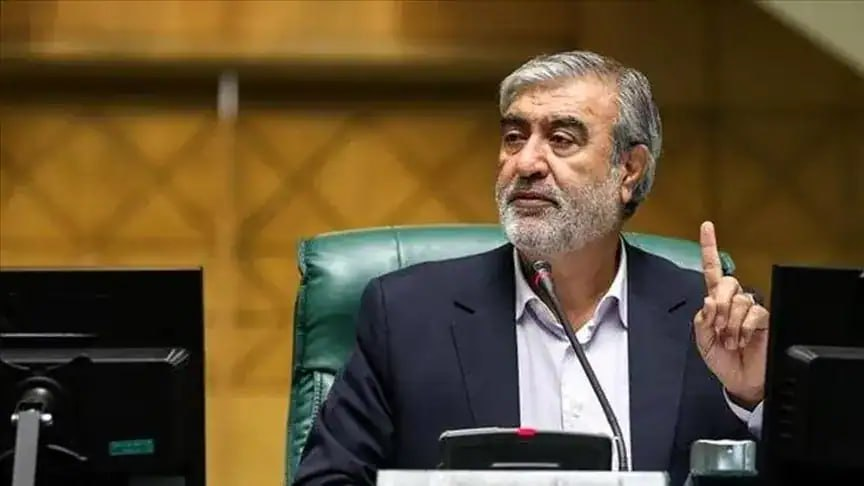
Head of the National Security Committee of the Iranian Parliament Ebrahim Azizi said on Sunday evening that Iran would only accept proposals in negotiations that are of national interest, reported Al Jazeera, noting that Azizi also emphasised the negotiations in Pakistan must yield tangible results and that the negotiation team won’t accept any demands on them, adding that he urged the US to accept the new system for the Strait of Hormuz and noting that there has been no change to Iran’s position regarding matters of national interest.
An Iranian Source told Al Jazeera that in light of Trump’s statements about holding negotiations and inconsistency with what is actually happening between Iran and the US: “We believe we are facing a deception by the enemy and we are on the verge of a new round of escalation.”
Israeli Channel 12 reported that the framework discussed between Iran and the United States in recent days allegedly includes a cessation of uranium enrichment for 15 years, conversion of enriched uranium into reactor fuel, with full IAEA oversight of nuclear sights, while the opening of the Strait of Hormuz, an end to the war and withdrawal of American forces, as well as the removal of economic sanctions.
Pakistan has deployed around 10,000 additional security personal in Islamabad in preparation for possible talks that could happen Tuesday should Iran and US come to terms over a framework for the negotiations.
Iran News:
Hardline factions in Iran had intensified their influence over decision-making, complicating efforts to maintain a consistent position in negotiations with the United States, reported the WSJ, stating that a recent reversal over the status of the Strait of Hormuz exposed divisions between Iran’s diplomatic leadership and military elements, particularly the IRGC, which was angry that Foreign Minister Abbas Araghchi didn’t coordinate with them before announcing the opening of the Strait.
The anger was expressed almost immediately, and that night a message from someone identifying themselves as a member of the IRGC Navy broadcast a radio message relaying the Strait would remain closed: “We will open it by the order of our leader, Imam Khamenei, not by the tweets of some idiot,” they said.
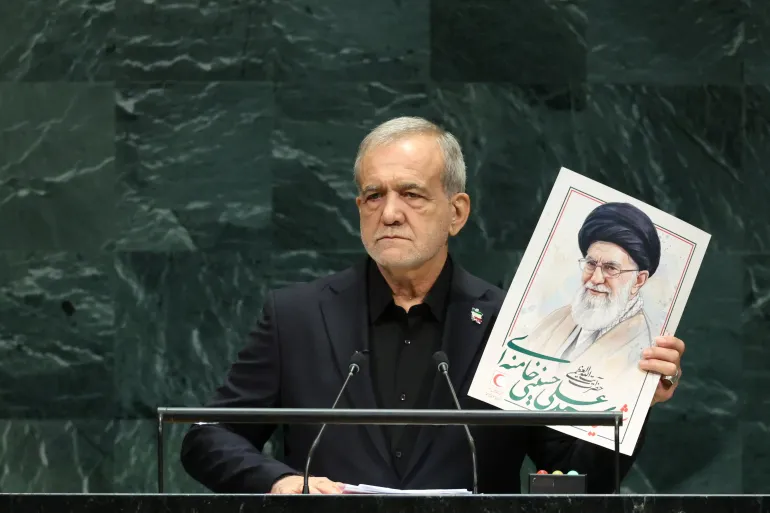
President Masoud Pezeshkian said US President Trump had no justification to deprive Iran of their nuclear rights.
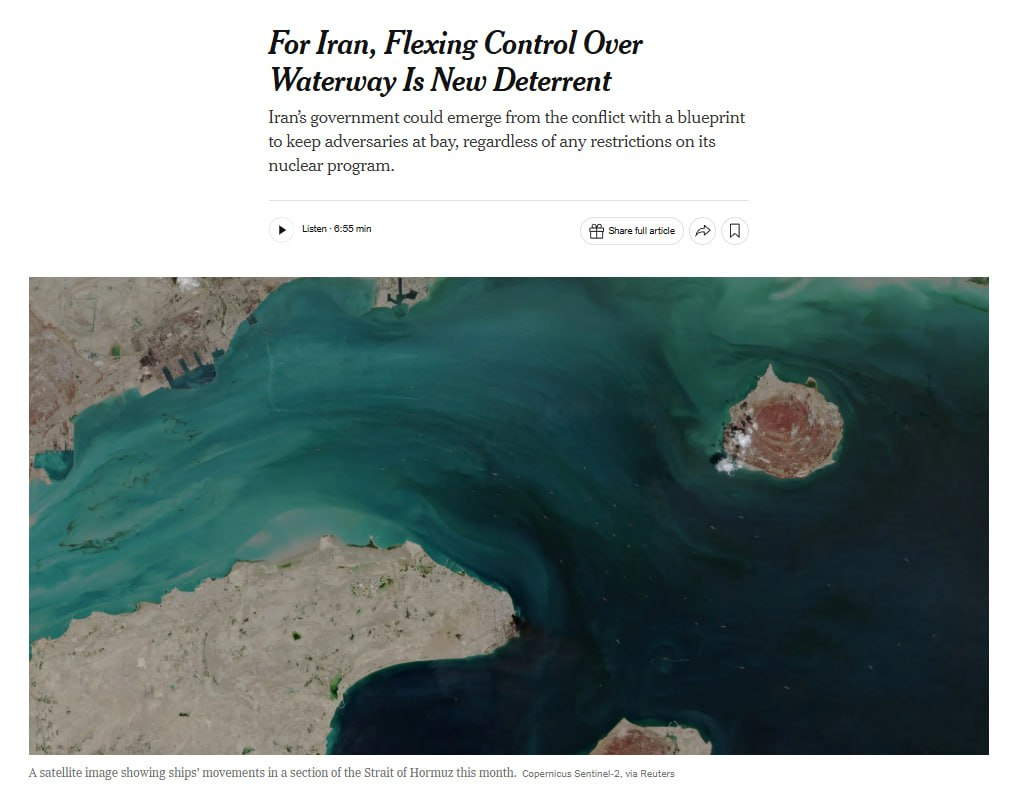
Iran is assessed to have retained a significant military capacity, including 40% of its attack drones and roughly 60% of its missile launchers, along with up to 70% of its missile stockpile, reported the NYT, noting that when the ceasefire took effect on April 8, Iran had around half of its ballistic missile launchers available, but has since likely recovered around 100 additional launchers from underground, raising the capacity to roughly 60% of pre-war levels, while US intelligence officials said Iran was working to recover buried missile stockpiles too, which could bring its total arsenal back to around 70% of pre-war levels once efforts are complete.
The Islamic Republic of Iran has agreed to transfer uranium to Pakistan and then to America, reported several sources on Sunday evening, noting that there is an agreement in principle to transfer Iran’s uranium to Pakistan, but Iran has not confirmed this and said their uranium will not be leaving Iranian borders.
Israel Hayom also reported that Iran had agreed to surrender its enriched uranium, but according to the source, the destination remained unclear, which could be Russia or the IAEA, while noting that progress had also been made on the issue of regional proxy funding, though Iran was demanding it be allowed to continue providing what it calls ‘non-military’ aid.
An explosion sound in Larak was as a result of a controlled explosion, reported the Qeshm Governorate, stating that it was the remaining ammunition from the 40-day imposed war, and in the next 48 hours, further neutralisation operations would be carried out in some parts of the country, which isn’t a cause for concern, said Fars News Agency.
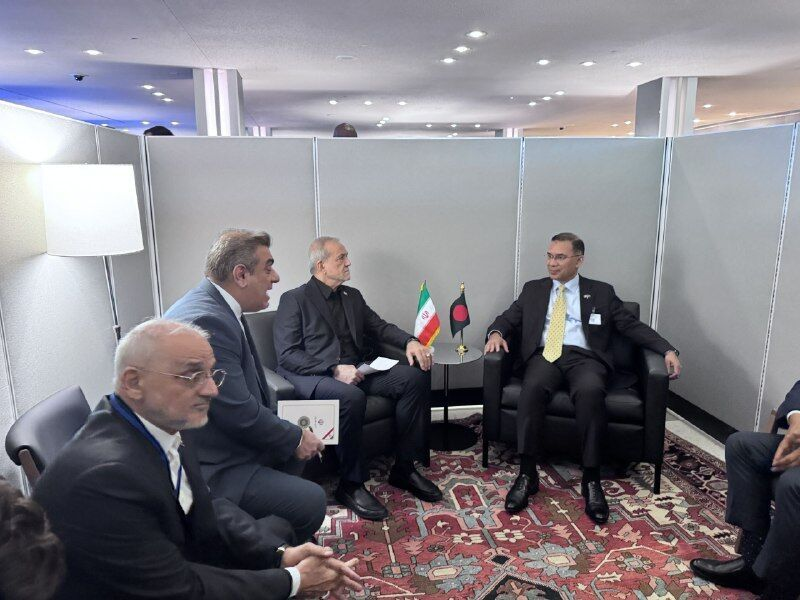
Iran’s President Masoud Pezeshkian held a 45-minute phone call with Pakistan’s Prime Minister Shehbaz Sharif to discuss the current regional situation, in which Sharif briefed Iran’s President on his recent talks with leaders from Saudi Arabia, Qatar and Turkey, saying the discussions helped build support for continued dialogue and diplomacy to achieve lasting peace in the region.
USA News:
President Trump furiously yelled at his aides when informed that a fighter jet had been shot down, ordering the military to go get the missing pilots immediately, however, the WSJ claimed that Trump was kept out of the war room during the search and rescue operation believing that his impatience would be unhelpful.
The fear of putting troops in harms way loomed over Trump’s head, which is primarily the reason he overlooked the operation to capture Kharg Island, which he was told would be successful, but feared it would lead to unacceptably high casualties, and said the troops would have been sitting ducks.
Kamala Harris was speaking live on Alex Witt Reports, stating that Trump got pulled into a war by Bibi Netanyahu: “He entered a war that the American people do not want, putting US service members at risk,” adding that fuel prices are up at least 50% due to the war.
President Trump told Fox News that if Iran didn’t sign a deal, the whole country was going to get blown up, adding that Special Envoys Witkoff and Kushner will travel to Islamabad this week for talks.
General News:
The General Command of the Bahrain Defence Force announced that its weapons and units were at the highest level of readiness and defence preparedness on Sunday morning, reported Sabereen News.
Japanese fishermen have been severely impacted by the rise of crude prices, reported the Japan Times, stating that while Japan sources most of its oil from the Middle East, the war with Iran had put additional pressure on this sector.
Reuters reported that due to the war in Iran, the global oil market had lost more than $50 billion worth of oil that wasn’t produced, while according to estimates, the impact of the unproduced oil will be felt for months, or even years.
The Israeli Security Cabinet convened on Sunday evening as rhetoric escalated between Iran and the US, reported Israeli Channel 12, adding that a full cabinet meeting is scheduled for Monday afternoon, noting that Israel assessed President Trump wanted a deal, while the ceasefire could be extended if no deal is reached in Pakistan, however, preparations were also underway for renewal of hostilities.
According to a Senior Israeli official: “We cannot say for certain where things are heading, if you put the presidents statements into ChatGPT, the chat would crash – as before, Trump wants negotiations, but Iran’s hardline position could lead to a resumption in fighting.”
Trump warned on Sunday that if Iran doesn’t take a deal, the US will bomb every power plant and bridge in Iran, reported Channel 12, stating that Israel was also drawing up a list of targets should fighting resume, though officials stressed these are not necessarily infrastructure targets, adding that the transition from ceasefire to renewed fighting could be very fast, and all relevant systems were preparing.
In the event of war breaking out and infrastructure being targeted again, Iran may abandon the restraint it demonstrated, reported Tasnim News Agency, noting that areas such as Bab al-Mandab, Aramco, Yanbu and Fujairah were all at risk.
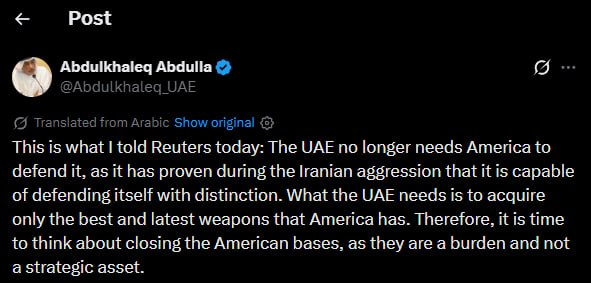
UAE commentator Abdulkhaleq Abdulla took to X saying it was time to think about closing the American bases in the region, noting they are more of a burden than a strategic asset.