 AJ
AJ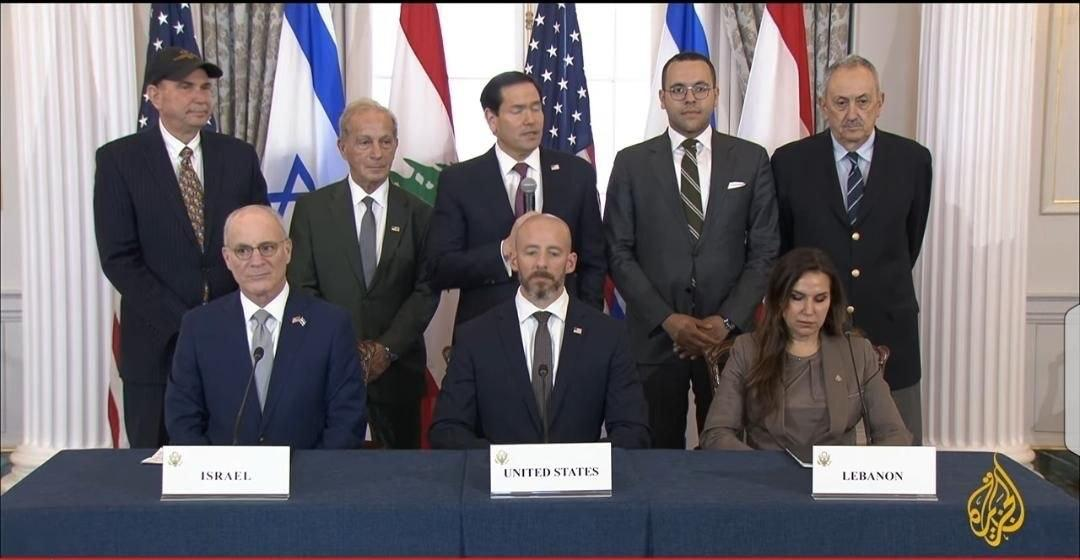
⚡️ Four days of talks in Washington, mediated by the US State Department between delegations from Lebanon and Israel, eventually resulted in an agreement that was signed in the presence of US President Trump, effectively bringing the war to the end.
🔹 As details of the agreement were revealed, many Lebanese media directors and journalists weren’t happy with the decision, stating that Israel had achieved everything they wanted, while Hezbollah promised a ‘civil war’ if the agreement went ahead.
🔹 Reactions and more in a long read, as AJ News reviews what happened in the talks, and the aftermath on Friday night.

MEDIA SPECULATION AHEAD OF THE SIGNING:
⚡️ MTV Lebanon reported that the discussions in Washington on Friday had entered the stage of ‘detailed drafting,’ especially since Lebanon wasn’t participating in negotiations in Switzerland, stating that Lebanon wanted the statement to include clear elements, including sovereignty and the role of the Lebanese Army, to link any model areas to an Israeli withdrawal, but Israel was seeking security guarantees and the prevention of the rebuilding of Hezbollah’s infrastructure.
🔹 According to MTV, the declaration of intent had stalled due to the model areas, because Israel wanted the Lebanese Army to be deployed in the areas it didn’t currently occupy, which would mean areas where Hezbollah currently operated.
🔹 IDF said the framework set to be signed included an Israeli commitment to withdraw IDF forces from parts of southern Lebanon under the pilot arrangement, under which the Lebanese Armed Forces will assume responsibility for those areas, and the agreement is also expected to include mutual recognition by Israel and Lebanon of each other’s sovereignty over their respective territories.
🔹 Al Jazeera was told by a Lebanese official that the framework would include the Lebanese Armed Forces taking over according to a phased timetable, stating that the withdrawal schedule is intended to pave the way for a full Israeli withdrawal at a later stage, adding that the text of the framework has been finalised and was expected to be signed on Friday, after all parties formally approved the declaration of intent.
🔹 KAN News (Channel 10) said the Lebanese Armed Forces will deploy into two pilot areas vacated by Israeli forces as part of the framework reached in Washington, and Israeli troops will remain in a broader security zone until ‘Hezbollah is disarmed,’ noting the sides also reached understandings on addressing Hezbollah’s tunnel network and military buildup, as well as launching future negotiations over the land border between Israel and Lebanon.
AGREEMENT SIGNED IN WASHINGTON:
⚡️ Officials from Israel and Lebanon signed the US-brokered framework agreement in Washington, and the two countries will now launch formal talks at the official level.
🔹 Israeli Prime Minister Benjamin Netanyahu was the first to issue a response, issuing a televised speech which told citizens of Israel that there was a great achievement for the State of Israel, stating the negotiations ‘have borne fruit.’
🔹 Netanyahu said that most important first and foremost was that Israel remained in the security zone in southern Lebanon, which he hailed as a great achievement, because Israel would maintain it as long as Hezbollah refused to disarm, and as long as there is a threat to the State of Israel.
🔹 The Prime Minister also boasted it was a major blow to Iran, who was trying to force Israel to withdraw by force from southern Lebanon, claiming that Israel, Lebanon, and the US were telling Iran ‘this is none of your business,’ adding that Iran have no role in Lebanon: “Neither you, nor Hezbollah, nor any terrorist organisation,” he said.
🔹 Netanyahu said that Israel are allowing the Lebanese Army to begin organising to take control of territory, noting the two pilot areas, both recommended by the IDF, and one is actually outside the security zone, south of the Litani River, while the second is north of the Litani, a small part of it in the expanded security zone that Israel secured in the last two weeks, but the IDF doesn’t need it, and it says this very clearly.
🔹 Israel constantly maintains the original security zone out of anti-tank missile range, not allowing Hezbollah to enter there, or returning residents: “It is preserved,” he said, adding: “And the most important thing is that Israel says: our security comes first.”
🔹 US Secretary of State Marco Rubio announced the creation of a US-facilitated tri-lateral military coordination group for Lebanon, pledging $100 million in immediate humanitarian assistance, to be distributed in accordance with the United Nations.
🔹 Rubio also announced that the Department of War was prepared to reimburse the Lebanese Armed Forces with more than $30 million to strengthen their operational capacity, while also supporting Lebanon’s sovereignty and security as part of Washington’s broader regional strategy.
🔹 During the signing of the document, Israeli Ambassador to the US, Yechiel Leiter, praised his Lebanese counterpart: “I want to thank Her Excellency, Ambassador Hamadeh, for being a very tough negotiator,” he said, saying she and her team set up an example for patriotism for Lebanon: “You fight like a lioness, Ms. Ambassador,” he added.
🔹 Leiter said the agreement was a performance-based trilateral framework agreement: “Iran is out, Hezbollah is out, and the road to peace between Israel and Lebanon is in,” he said.
🔹 AIPAC issued a press release welcoming the framework agreement, calling it an ‘historic step’ toward peace, praising President Trump and Secretary of State Marco Rubio for brokering the deal, and the pro-Israel lobbying group said the agreement marked a significant step toward restoring Lebanese sovereignty by disarming Hezbollah and reducing Iranian influence in Lebanon.
REJECTIONS OF THE AGREEMENT:
⚡️ Hezbollah MP Hassan Fadlallah, a member of Lebanon’s Loyalty to the Resistance Bloc, has categorically rejected the Washington framework, reaffirming Hezbollah’s opposition to direct negotiations, while calling on the Lebanese authorities to reverse the course of direct talks and ‘all the decisions taken against their own people.’
🔹 Fadlallah also denied reports claiming Hezbollah’s position has been formulated during meetings between himself and Lebanese security officials, insisting that the party’s rejection of direct negotiations had been clearly conveyed to the relevant authorities.
🔹 Speaking to Al Mayadeen, Fadlallah said the Israeli Prime Minister was ‘negotiating with himself,’ arguing that Lebanon’s current authority lacked the constitutional and national legitimacy to make such commitments or impose them on the country.
🔹 Fadlallah warned that the agreement could not be enforced ‘unless it resorts, with American backing, to a civil war,’ adding that the negotiations were an attempt to derail the MoU track and that ‘without the Resistance, nothing will pass.’
🔹 According to Fadlallah, the ‘decisive factor is the battlefield, and we control the battlefield because we are the people of this land,’ adding that Hezbollah would confront any measures taken by the authorities and ‘cling to its resistance and its weapons even more.’
🔹 Fadlallah said Hezbollah’s ministers remaining in government ‘does not mean we approve the decisions,’ stating that the movement seeks no confrontation with the Lebanese Army, which he said was carrying out its duties professionally.
🔹 Iran’s position remained clear, Fadlallah further said, stating that Tehran ‘will not sign any agreement before an Israeli withdrawal from Lebanon.’
🔹 Fadlallah then addressed Netanyahu directly, saying: “You reached an agreement with those who do not hold the direction,” insisting that the state of hostility with Israel would remain and that ‘whoever shakes hands with the enemy is a partner in its crimes.’
PRESS COMMENTS:
⚡️ Lebanese Journalist Hassan Illaik said: “This is a security normalisation agreement, an agreement of subordinate alliance under which Joseph Aoun becomes a subordinate to Netanyahu, as well as to any future Israeli prime minister.”
🔹 Illaik said that in addition to establishing a joint security committee, granting the United States control over reconstruction, and effectively making the Israeli army the overseer of the Lebanese Army to verify that it carried out its obligations, Joseph Aoun also pledged not to pursue the Israeli entity for any crimes it has committed in the past or may commit to the future, effectively granting the Israeli entity legal immunity, shielding it from prosecution before any international institution, whether judicial or political.
🔹 “I was already aware of the general direction of the agreement,” he concluded: “But this clause exceeded every expectation in its sheer disgrace.”
DEMONSTRATIONS AGAINST THE AGREEMENT:
⚡️ Lebanese civilians took to the streets of Dahieh, Beirut, protesting against the agreement that was signed, closing at least two roads, while forcing the Lebanese Army to eventually get involved and disperse crowds, first using tear gas and batons, and eventually firing warning shots into the crowds.
🔹 Most people in Lebanon, especially Shias, considered the agreement a betrayal, saying it amounted to a ‘normalisation move,’ noting that among other things, the deal included a plan to combat Hezbollah together.
SHORT VERSION OF THE 14-POINT AGREEMENT:
🔹 1. End the conflict and formally work toward ending the state of war.
🔹 2. Israel will withdraw from Lebanon in phases as security conditions are met.
🔹 3. The Lebanese Armed Forces will gradually assume control of security across the country.
🔹 4. Hezbollah and all other non-state armed groups must be completely and verifiably disarmed.
🔹 5. Israel says it has no territorial ambitions in Lebanon and will leave once security threats are removed.
🔹 6. Lebanon reaffirms that only the Lebanese state has the authority to wage war and maintain armed forces.
🔹 7. A US-backed military coordination and verification mechanism will oversee implementation of the agreement.
🔹 8. Both sides commit to a sovereign, secure Lebanon free of armed groups threatening either country.
🔹 9. The US will support and strengthen the Lebanese Armed Forces, with assistance tied to verified progress.
🔹 10. The US will coordinate international reconstruction, humanitarian aid and economic recovery for Lebanon.
🔹 11. Lebanon and the US will prevent funds and reconstruction assistance from reaching Hezbollah or other armed groups.
🔹 12. Israel and Lebanon will establish working groups to negotiate a comprehensive peace and security agreement.
🔹 13. Both sides will cease hostile political and legal actions and cooperate on the return of detainees and human remains.
🔹 14. Israel and Lebanon acknowledge the US role in the agreement and express appreciation for President Donald Trump’s leadership.