 AJ
AJ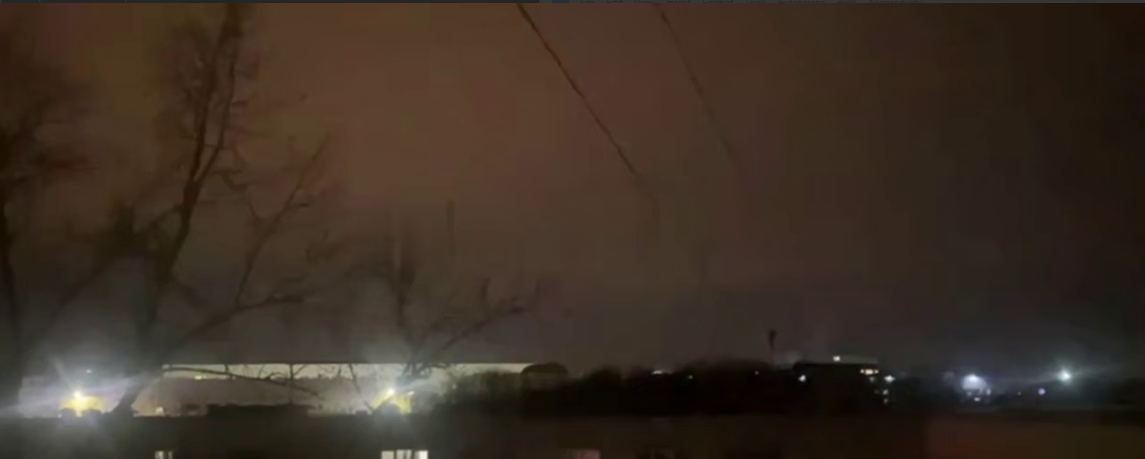
Prior to last night’s attack, Belgorod Governor Vyacheslev Gladkov had already reported that drones had “attacked” 12 populated areas of the Belgorod region.
Damage was caused to an apartment building in the Shebekino district, along with the balcony and interior decoration, while windows of other apartments were damaged as a result of the blast wave.
Another drone exploded on the premises of an enterprise, damaging the roof of an administrative building and shattering the windows.
Gladkov said that a drone attacked a car in the village of Arkhangelskoe and in the village of Ziborovka, where a car was damaged as a result of an explosion in Ziborovka.
Following a drone strike in the village of Belyanka, a fire broke out in the attic of an outbuilding, while windows were broken and the roof was damaged, while a car caught fire near a commercial facility in the village of Grafovka following a drone strike.
Gladkov said that the roof of a private house was damaged in a drone strike in the village of Nechaevka in the Belgorod district, as well as damage to an outbuilding in the settlement of Razumnoe as a result of the debris from a downed drone.
In the Grayvoron district, a drone attacked a car and the explosion damaged the windows of three apartments in a multi-family house, while another drone damaged power lines in the village of Smorodino, and a car was damaged in a drone explosion in the village of Novostroevka-First.
Windows of three private houses were damaged in drone attacks in the village of Borisovska in the Volokonovsky district, while a drone caused damage to an outbuilding of a private house when it exploded on the premises in the hamlet of Leonovka in the Valyusky district.
Gladkov later confirmed information that had previously been reported by Belgorod news outlet Pepel about a drone strike on a gas station in the Severny settlement of the Belgorod district.
During the drone strike, a man at the gas station suffered a barotrauma, while damage was caused to the station canopy, equipment, and a car that was parked at the site.
NOW TO LAST NIGHT’S ATTACKS:
Before striking the power substations in Belgorod, the Armed Forces of Ukraine reportedly attacked the air defence positions in the Belgorod region.
According to the channel Spionage Dossier, which specialises in leaking attacks on military facilities, on February 3 the AFU carried out strikes on the air defence positions.
During the day, using strike UAVs, attacks were carried out on three positions of mobile radar stations, putting two of them out of action.
At night, the AFU struck air defence positions in the village of Novoselovka, which is a village in the Starooskolsky district, but the results of the strike were unknown.
According to the channel, at the Belgorod 330 power substation, which was hit by two Himars missiles, damaged two transformers.
Pepel later reported that the Frunzensky power substation in the village of Dragunskoe was hit by Ukrainian shelling, while eyewitnesses reported at least five hits at the site, which was earlier targeted by attack drones.
Missile strikes also hit the Belgorod Thermal Power Station, leaving some areas of the city without power and heat.
Belgorodenergo were still unable to update a timeline for restoration of the electricity supply this morning, as the website indicated there were numerous damages recorded to the electrical equipment at the Fruzenskaya electrical substation and the Belgorod TPP.
As well as heating and water disruption, residents of Belgorod also began reporting supply issues with their water, as the Water Supply Company stated: “We are assessing the scale of the disruptions – it will take up to two hours to analyse the situation at all the facilities.”
Mayor Valentin Demidov later confirmed that after the strikes, there was “serious” damage to the infrastructure, leading to disruptions in the supply of electricity, heating and water.
Gladkov announced later that a “large amount of damage to the energy infrastructure” of the city of Belgorod, as well as the districts of Belgorod, Rakitinsky, Borisovsky, Gravoronsky and Yakovlevsky.
However, Gladkov was still unable to provide details for the timeline of restoration, citing the fact that Ukraine was carefully analysing the current situation.
Gladkov later reported that restoration of the networks were ongoing, but schools and kindergartens were still operating in-person today, and Gladkov intended to visit the educational facilities connected to backup generation to make additional decisions if necessary.
Residents of the Belgorod districts were being advised that they could charge their phones for free at municipal-owned institutions, cultural centres, libraries and other locations, but not kindergartens, schools or vocational education institutions due to security requirements.
Elevators were shut down again following the blackout, as 113 residents were trapped in the elevators for two hours this morning, so to ensure safety of the residents, the elevators would be stopped.
Students from multiple schools reported lack of utilities this morning, but children were still told to attend classes and wear jackets, however some schools later closed due to the situation.
Residents of Belgorod were beginning to complain this morning too, as temperatures dropped and they had to use electric storage heaters, while others reported lack of water and electricity, noting that Emergency Services aren’t responding to the residents’ requests.
Mothers and babies at a perinatal centre in Belgorod were forced to warm themselves with heaters due to a lack of heating, with one husband of a patient stating that heating and hot water disappeared from the medical facility which houses patients and newborn babies.
Temperatures soon started to drop, stated the husband, and when patients asked why the backup generators hadn’t been turned on, the centre’s administration gave the women heaters.