 AJ
AJ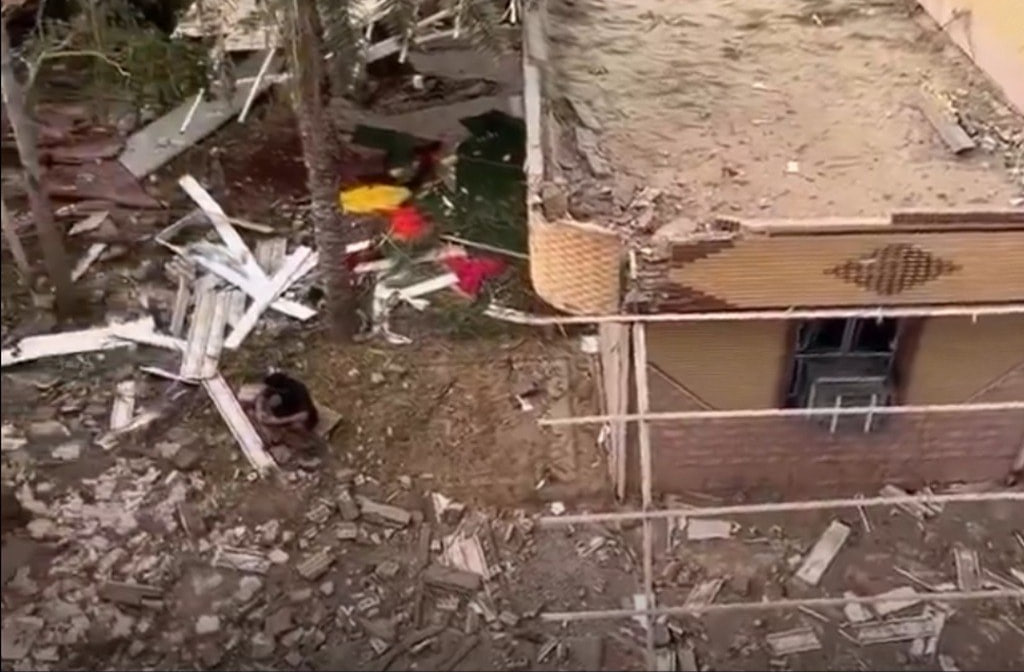
⚡️ USA missed possible target in Kohstak by 200 metres according to an IRGC announcement
➡️ During the attack on Iran by the US forces on Tuesday, the IRGC reports the United States had used a weapon designed to precisely strike pre-determined targets, having found remnants of what appeared to be a guided glide bomb in the residential building that had been struck, adding that images released by CENTCOM of attacks showed an F/A-18 Super Hornet fighter jet carrying a bomb of this type.
🔹 The IRGC said that the residential building that had been struck is located approximately 200 metres from a communications tower, and the possibility of error at this distance for the type of munition is unacceptable, claiming the strike was clearly intentional, resulting in the deaths of five people, including a four-year-old child.
🔹 According to the announcement, analysis of images of the remaining munition fragments had provided new clues about the type of weapon used, claiming that among the fragments was a thermal warning battery, sensitive electronic components, mechanical components related to control systems, and a large aerodynamic surface were visible.
🔹 The report suggested that the combination of the indicator, along with the design of the American long-rage munition, ‘is most consistent with the AGM-154 JSOW family, and among the different versions, the remnants are more compatible with the AGM-154C/C-1.’
🔹 US-owned AGM-154 JDSOW long-rage guided glide munitions are designed to precisely strike targets from a considerable distance, the report continued, stating that Versions C and C-1 use GPS/INS guidance and an infrared image seeker in the terminal phase, and are equipped with a multiple-stage BROACH warhead; a system developed for precise engagement with point targets and hardened structures, while in addition to these capabilities, the C-1 version also has a datalink for receiving target updates mid-flight.
🔹 The report said it is important to note that current evidence makes the use of a Hellfire missile or similar small munition highly unlikely, noting that the dimensions of the fragments, the structure of the control surfaces, the electronic equipment, and the internal systems remaining are more consistent with a large gliding munition such as the JSOW, adding that the assembly is less consistent with the SLAM-ER hypothesis, as the SLAM-ER is a powered cruise missile, and more distinct remnants of its propulsion and missile structure would have been expected.
🔹 Concluding the report, the IRGC said that the remnants are highly likely to belong to the AGM-154 JSOW family, and more likely to be the AGM-154C/C-1 versions, however, a definitive distinction between the C and C-1 models is not possible without finding a specific part number, CAGE Code, or specific components related to the datalink.