 AJ
AJ
Recap from the Sixth day of the US-Iran ceasefire, which includes looking at whether the US blockade has taken effect, the possibility of future Iranian talks being discussed, and various officials expressing various views.
US Blockade of the Hormuz Strait:

Hours before the 10am (Eastern Standard Time) deadline set by President Donald Trump for Iran to reopen the Strait of Hormuz or face a blockade of all ships carrying Iranian oil, many representatives and officials had something to say, and warnings to issue.
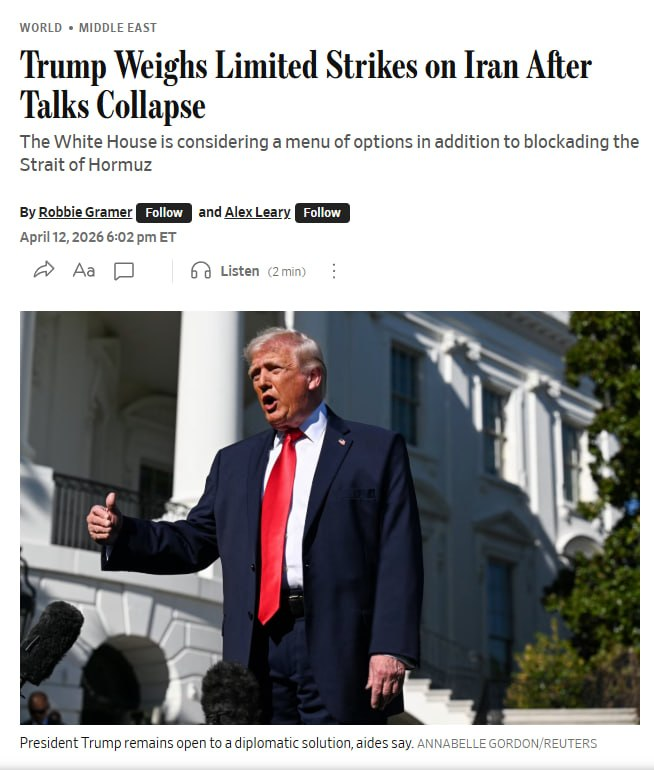
For example, the Wall Street Journal reported that President Trump and advisers were considering resuming limited strikes alongside the blockade, saying that officials discussed ideas after negotiations in Pakistan collapsed, but it was less likely because of the risk of further destabilisation in the region along with Trump’s reluctance for long-term conflicts. WSJ said another option under consideration was a more temporary blockade of the Strait of Hormuz while pushing allies to take on future escort roles for shipping through the Strait.
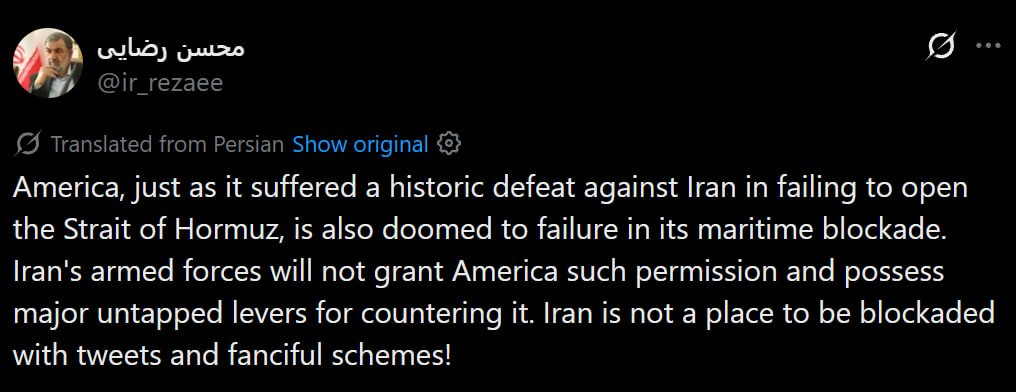
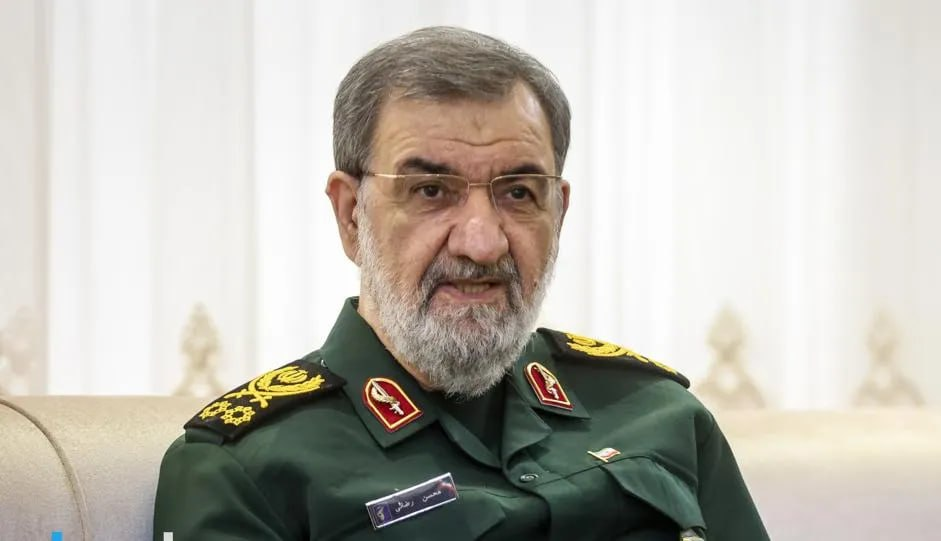
Senior Iranian official Mohsen Rezaee took to X saying that the US had already suffered an historic defeat in Iran and an attempt to enforce a blockade would also be doomed, because Iran’s armed forces wouldn’t grant the United States permission, and possess major untapped levers for counteroffensives, adding: “Iran isn’t a place to be blockaded with tweets and fanciful schemes!”
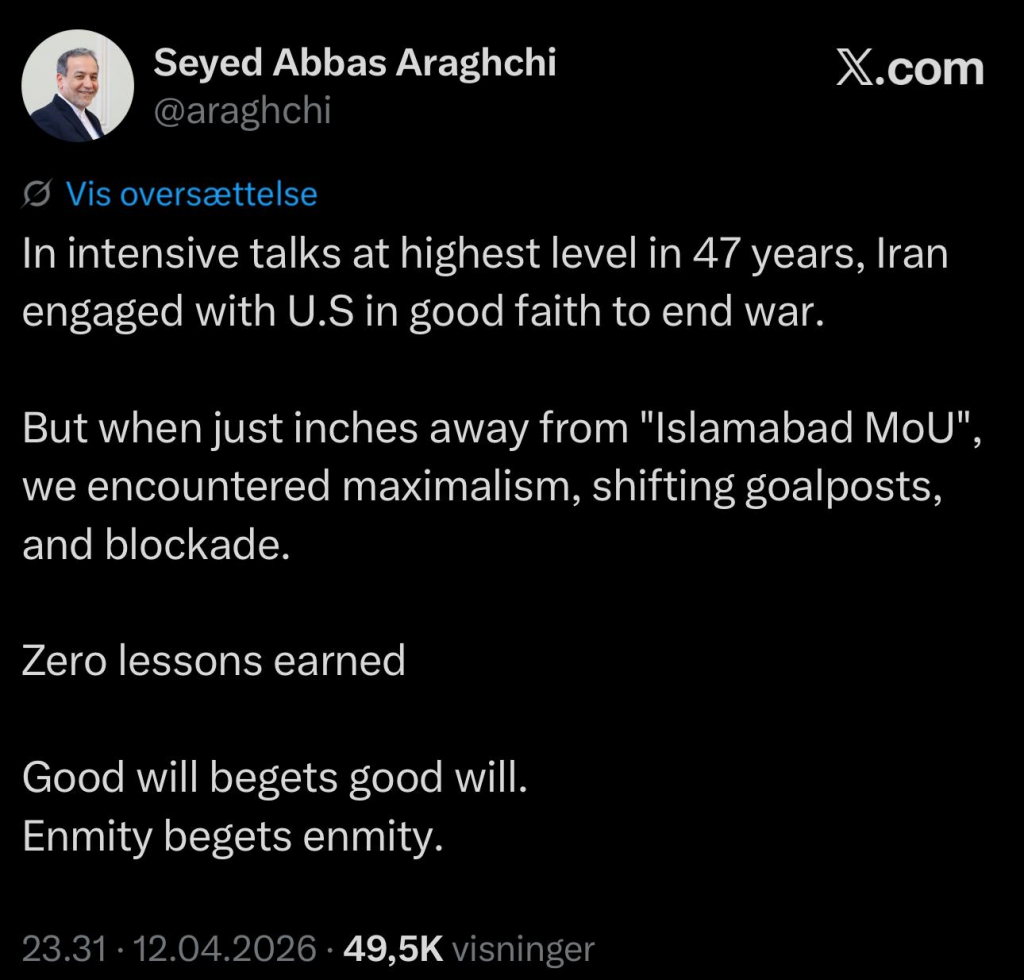
Foreign Minister Abbas Araghchi said on X that following the most intensive talks at the highest levels in 47 years, Iran engaged with the US in good faith, but when just inches away from “Islamabad MoU”, negotiators encountered maximalism, shifting goalposts, and blockade, adding that zero lessons were learned.
Israeli Finance Minister Bezalel Smotrich said in an interview with 94fm radio that its important President Trump was committed to preventing Iran having any nuclear capability, zero enrichment, removing all enriched materials, and opening the Strait of Hormuz, and when asked whether Iran would sit idly by, Smotrich replied: “We’re preparing for all possibilities, both in defence and offence, in full coordination with the Americans,” reported the Middle East Observer.
President Trump took to Truth Social to confirm that the United States would blockade ships entering and exiting Iranian ports seven and a half hours before the deadline.
China’s Foreign Ministry responded to Trump’s blockade deadline, saying that all parties should commit to calm and restraint, because a ceasefire and an end to the hostilities were necessary for the safety of navigation in the Strait, so China were willing and ready to work with all parties to ensure continuity of energy supplies without any obstacles, stating that maintaining security and safety of the Strait served in the common interests of the international community, reported Al Jazeera, adding that China hoped Washington and Tehran would abide by the ceasefire arrangements and make political efforts to avoid conflict.
Kremlin Spokesman Dmitry Peskov said the Blockade of the Strait of Hormuz would likely negatively impact global markets: “Many details remain unclear and incomprehensible, so I would refrain from making any substantive comments at this time,” he told reporters.
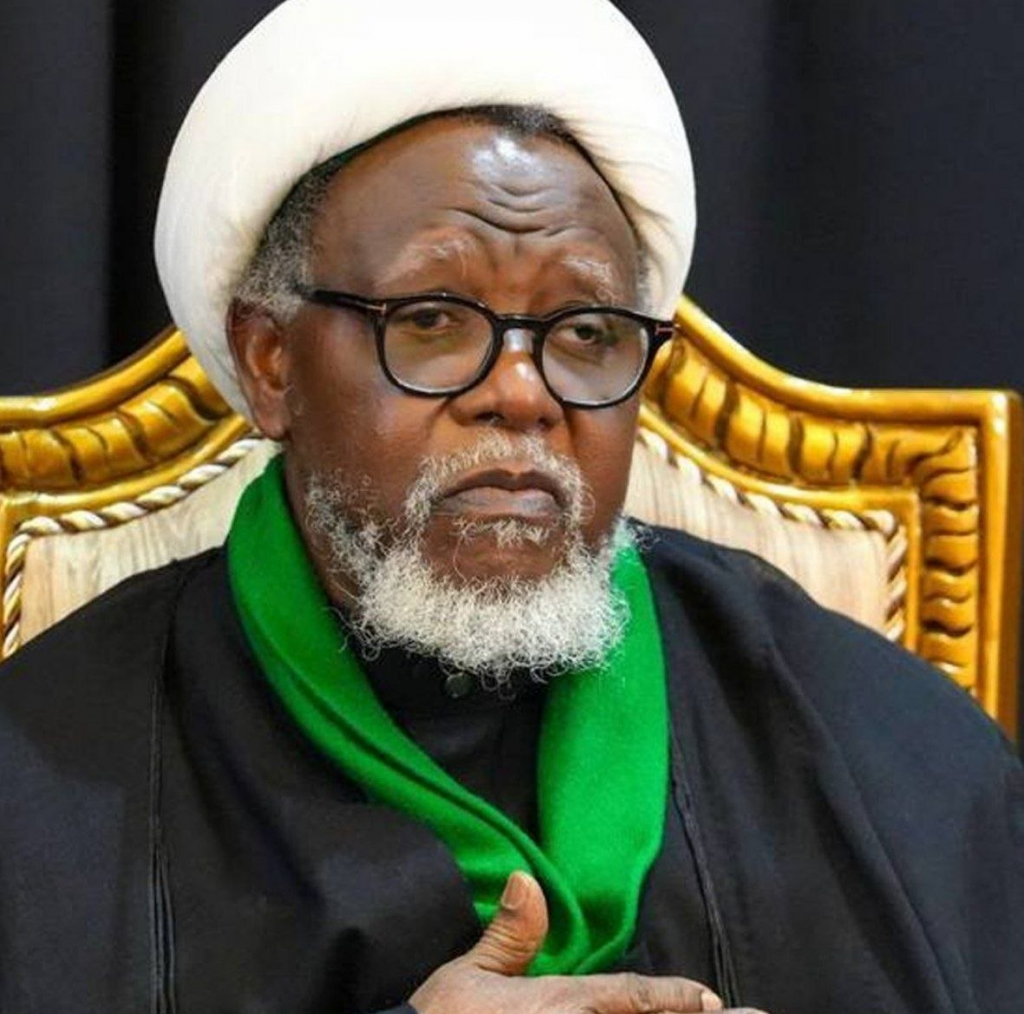
Leader of the Islamic Movement in Nigeria Sheikh Zakzaky weighed in on the subject, stating the Strait of Hormuz and Bab el-Mandeb were not ownerless territories, because they belong to the nations of Iran and Yemen, calling on the aggressor to withdraw, admit their defeat, and abandon any thought of launching new acts of aggression.
As the deadline moved closer, Reuters reported the US forces will be imposing control on the Strait of Hormuz from the Arab Sea and the Gulf of Oman, stated Al Jazeera and Kan News citing a US Memo, which included the movement of all ships regardless of which flag they fly, but the US Navy won’t hinder the passage from and to non-Iranian destinations, although some neutral ships may be subject to verification and inspection to detect the presence of smuggled goods, adding that shipments of humanitarian aid consisting of food, medical supplies and essential goods would also be allowed provided they are inspected first.
Iran threatened to close the Bab el-Mandeb, a gateway to the Red Sea, which would also disrupt trade, delay oil shipments, and drive up global oil prices, which would be supported and enforced by Yemeni Houthis.
American officials told Al Jazeera they were ready to impose a naval blockade at the deadline with enough forces in place to carry it out, while the timeframe will be as long as President Trump decides, but they wouldn’t address the possibility of the US Navy crossing the Strait to ensure the security of operations, and wouldn’t discuss the rules of engagement in the event of a violation of the naval blockade.
Deadline time came and so did a post from US Central Command, stating that the US Blockade of the Strait of Hormuz had begun, which would be enforced impartially against all vessels of all nations entering or departing Iranian ports and coastal areas, including all Iranian ports on the Arabian Gulf and Gulf of Oman. Centcom forces will not impede freedom of navigation for vessels transiting the Strait of Hormuz from non-Iranian ports.”
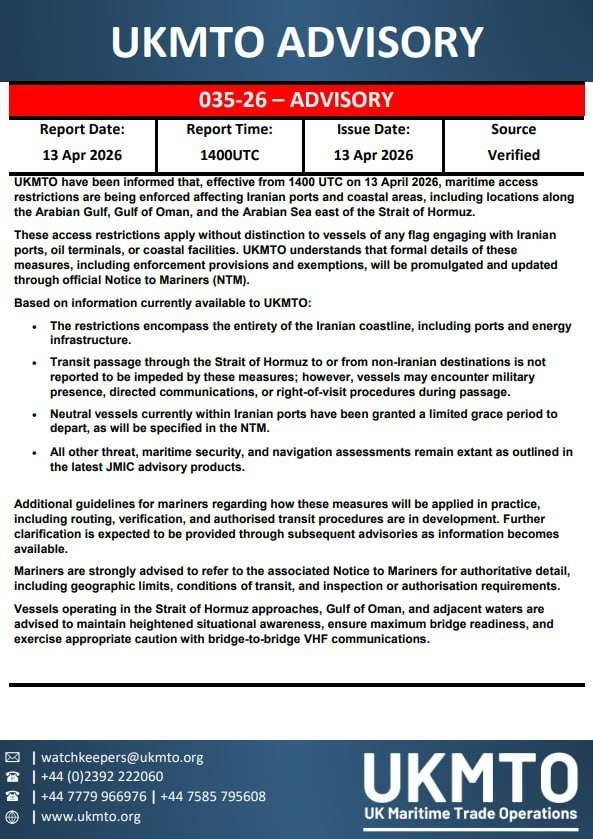
UKMTO announced maritime access restrictions affecting Iranian ports and coastal areas came into force at 1400 UTC (15:00 GMT) on 13 April 2026. Measures apply to vessels of all flags engaging with Iran ports, oil terminals, and coastal facilities across the Arabian Gulf, Gulf of Oman, and the Arabian Sea east of the Strait of Hormuz, and the restrictions cover the entire Iranian coastline, including key ports and energy infrastructure, while neutral vessels currently in Iranian ports had been granted a limited space to depart.
According to the Wall Street Journal, at least 15 US vessels were currently involved in enforcing the blockade, which would likely mean around 5 vessels on each route.
President Trump warned in a Truth Social soon after that Iran’s Navy were already obliterated and lying at the bottom of the sea, but the US hadn’t hit a “small number” of the fast attack ships because they weren’t considered a serious threat, but if any of these came anywhere close to the blockade, they would be eliminated using the same system that the US used to kill the drug dealers on the boats near Venezuela.
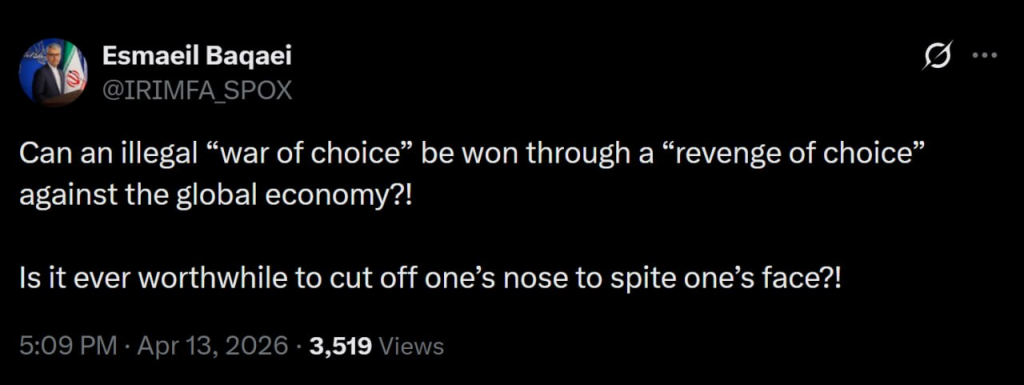
Iranian Foreign Ministry spokesperson Esmaeil Baghaei asked on X how an illegal ‘war of choice’ could be won through a ‘revenge of choice’ against the global economy, and whether it was ever worthwhile to cut off one’s nose to spite one’s face.
China responded to Trump in a letter regarding the blockade, stating that the Strait of Hormuz was not America’s territorial waters, neither in terms of control nor in terms of economics, warning that China had international trade agreements with Iran, wouldn’t back down and wouldn’t stop trade, continuing to send cargo ships to Iran through the US blockades near the Strait.
The US blockade of Iranian trade through the Strait of Hormuz had began to push global markets into renewed turmoil, with supply already under severe strain, because around ‘2 million barrels per day’ of Iranian oil exports could be removed from the market, intensifying a global scramble for crude, reported the WSJ, noting that Brent oil prices had surged to almost $101 a barrel, adding that shipbrokers weren’t clear how ships could satisfy both Iranian and US conditions on leaving the Persian Gulf, and tanker owners said they’d hesitate before sending new vessels to the Strait.
Movements in and around the Strait:
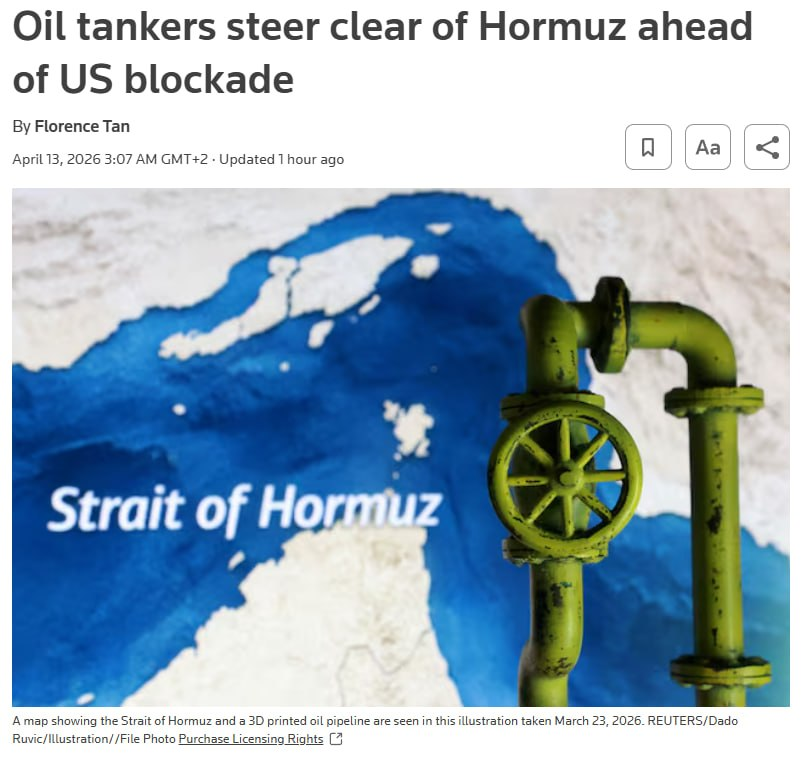
Tankers, rather than being encouraged by Trump’s speech and moving towards the Strait, were actually steering clear of the planned blockade, reported Reuters who cited shipping data information.
Iran had a dozen tankers in the Gulf of Oman holding around 23 million barrels of crude oil and would likely be the first target of the US Navy, reported Warfront Witness, noting that the tankers could potentially also seek refuge in friendly waters such as Pakistan in an attempt to escape the blockade.
Pakistan-flagged vessels Shalamar and Khairpur entered the Gulf, with Shalamar heading toward the United Arab Emirates to load Das crude and Khaipur bound for Kuwait to load refined products.
Mixed traffic patterns were observed in the Strait, including the Liberian-flagged VLCC Mombasa B which successfully transited the Strait and was operating in the Gulf, while the Malta-flagged Agios Fanouris I turned back after attempting to enter and was anchored near the Gulf of Oman.
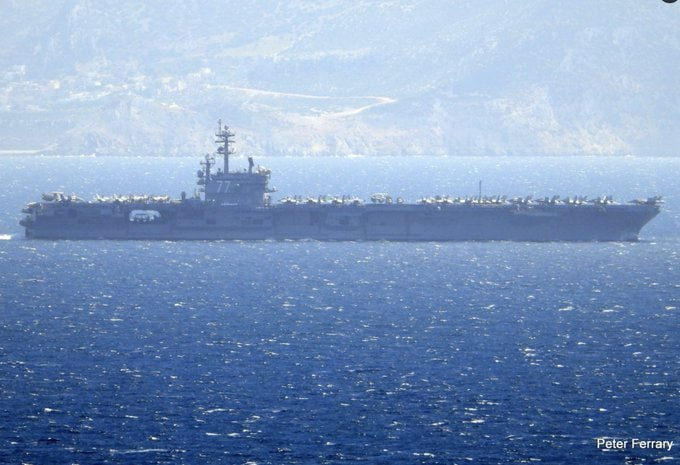
USS George H W Bush, the US’ third Navy aircraft carrier, had entered the Mediterranean sea, according to several reports on Monday, stating that it would take another 3 to 5 days for the carrier to arrive in the eastern Mediterranean Sea, meaning it would be in place in the area of operations before the ceasefire deadline.
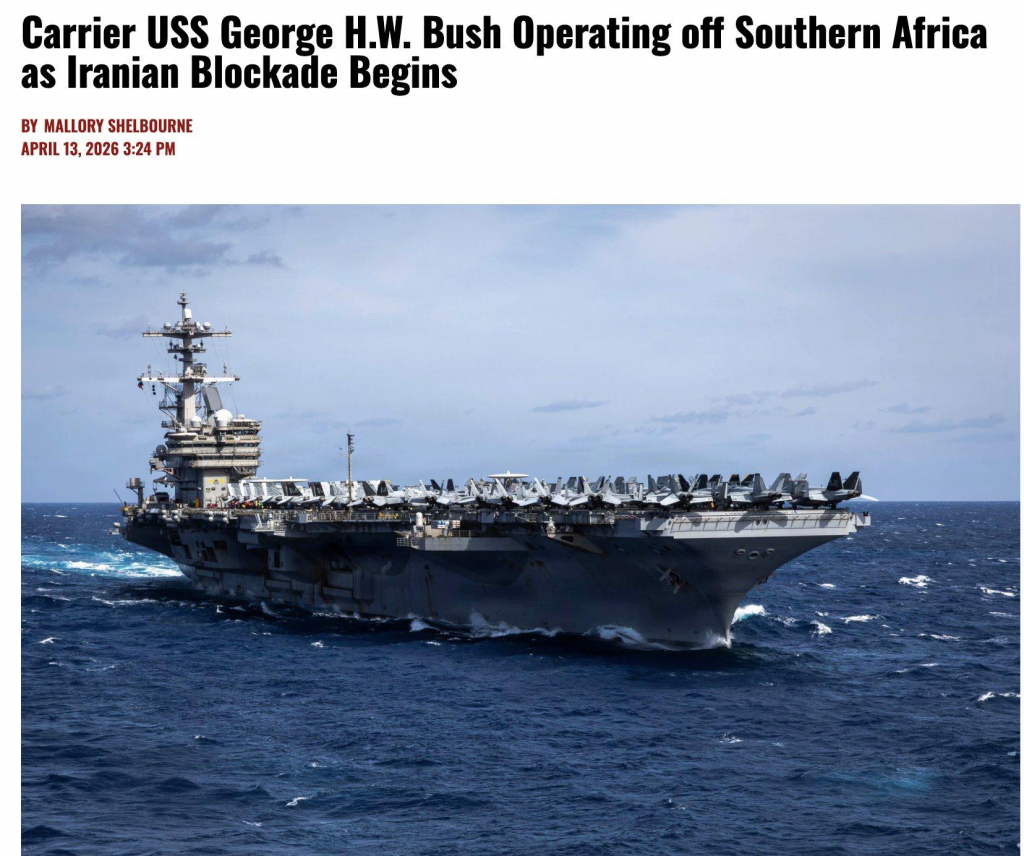
However, instead of taking the usual route through the Mediterranean and Red Sea, the USS George H W Bush was sailing the longer route around Africa to reach the Persian Gulf, reported USNI, stating that the detour avoided Houthi-countrolled waters like the Red Sea and Bab el-Mandeb, and at the time of reporting the carrier was operating off the coast of Namibia.
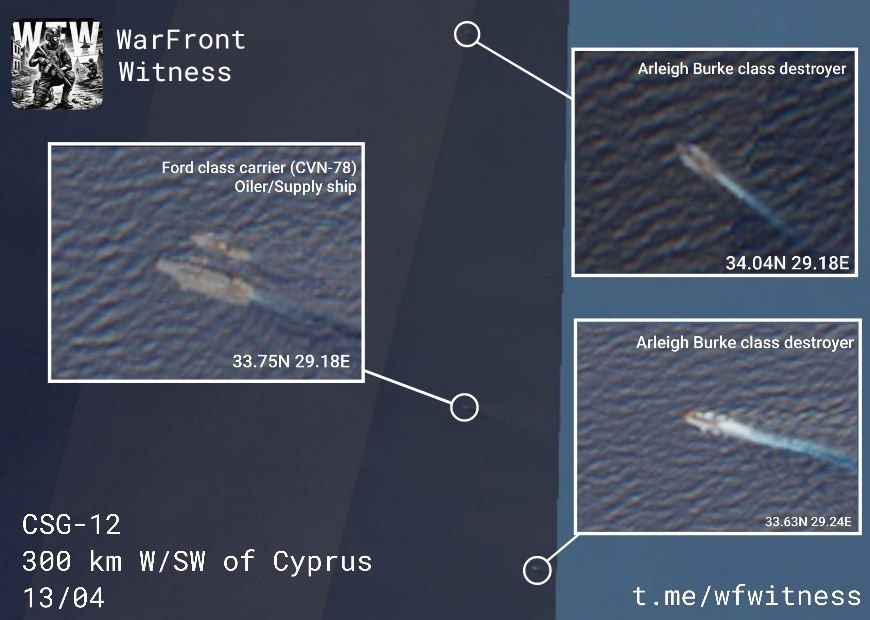
Meanwhile, the Gerald R Ford was operating on the east coast of Cyprus on Monday, reported Warfront Witness, noting that the carrier was already in the same area two days ago, is not in transit and is expected to remain in the area until such time as new orders are given, noting that the carrier can be refuelled by a supply ship and that they are flanked by a pair of Arleigh Burke class destroyers.
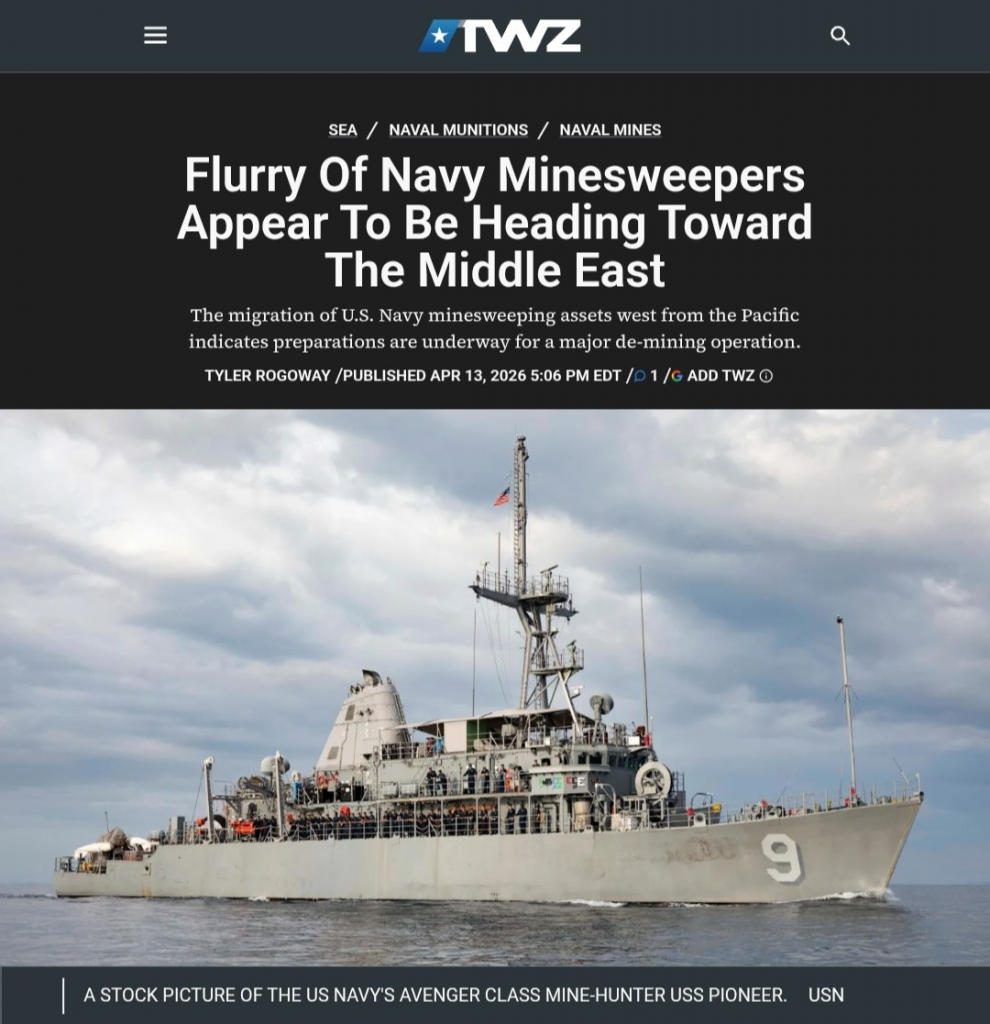
Further craft are being repositioned, reported TWZ, stating that US Navy Avenger-class minehunters from Japan which are being sent from the Pacific to the Middle East: “This movement signals operations to clear Iranian naval mines from the Strait of Hormuz, a critical chokepoint for global oil shipments, amid ongoing efforts to reopen the waterway following recent conflict-related disruptions.”
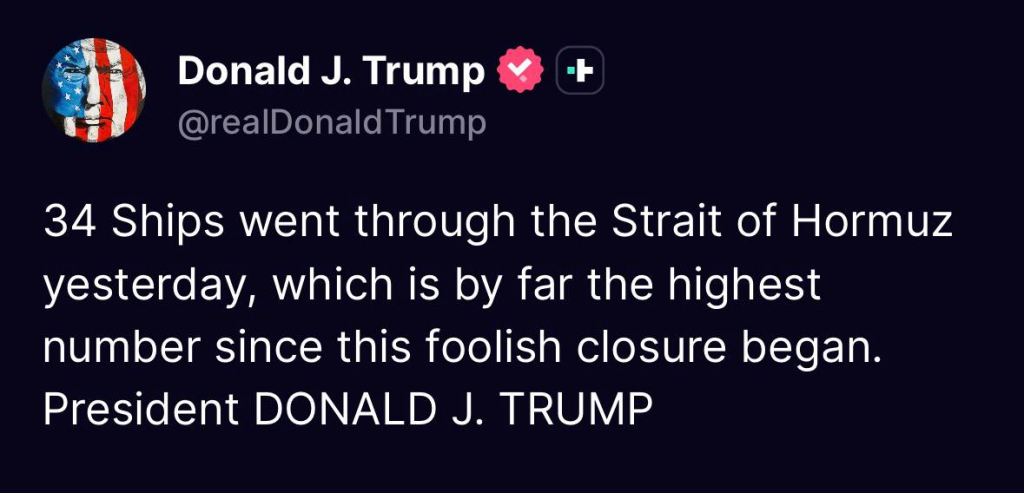
President Trump claimed that 34 ships went through the Strait of Hormuz on Sunday, the day before the blockade, noting its the highest number since the closure began.
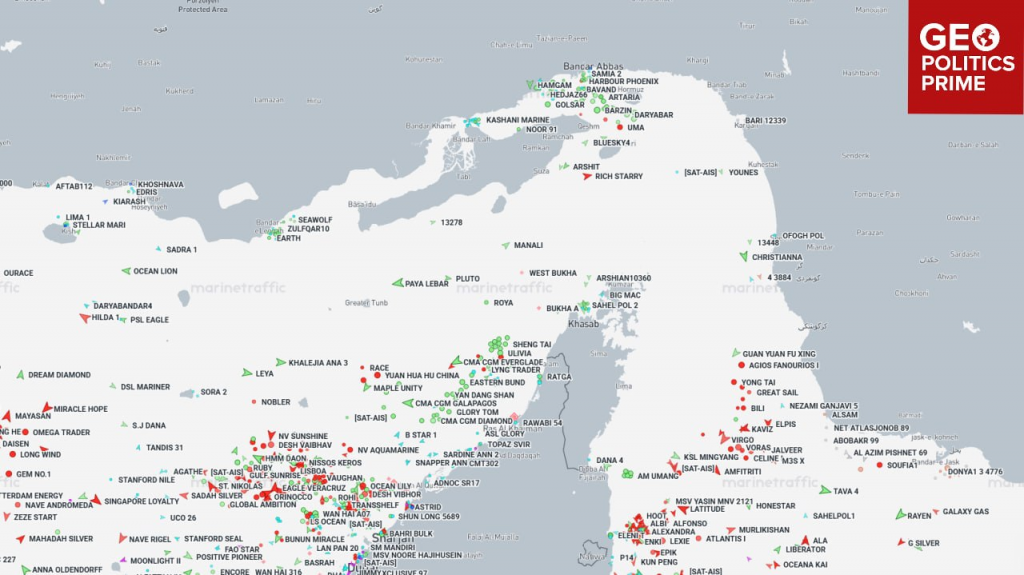
However, Bloomberg reported that 19 vessels had travelled the Strait on Sunday, according to Geopolitics Prime, showing a map that saw a sharp decline to just four ships that passed through the Strait on Monday.
Help with the Blockade?:
Australia’s Prime Minister Anthony Albanese said the US hadn’t asked the country to support the blockade on the Strait: “We’ve received no requests, and they’ve made this announcement overnight… in a unilateral way – we haven’t been asked to participate, [and] I want to see the resumption of peace talks,” adding that the war was going to have a devastating economical impact for years to come.
Japan was next to refuse, when Senior Cabinet Secretary of Japan Minoru Kihara said that Japan hadn’t made any decision to deploy its forces for mine-clearance operations in the Strait, that Tokyo was following developments ‘very seriously’ including negotiations and efforts to reduce tensions, adding that navigation is very important, but making it clear that no military action has yet been considered, reported Iranian news agency Tasnim News.
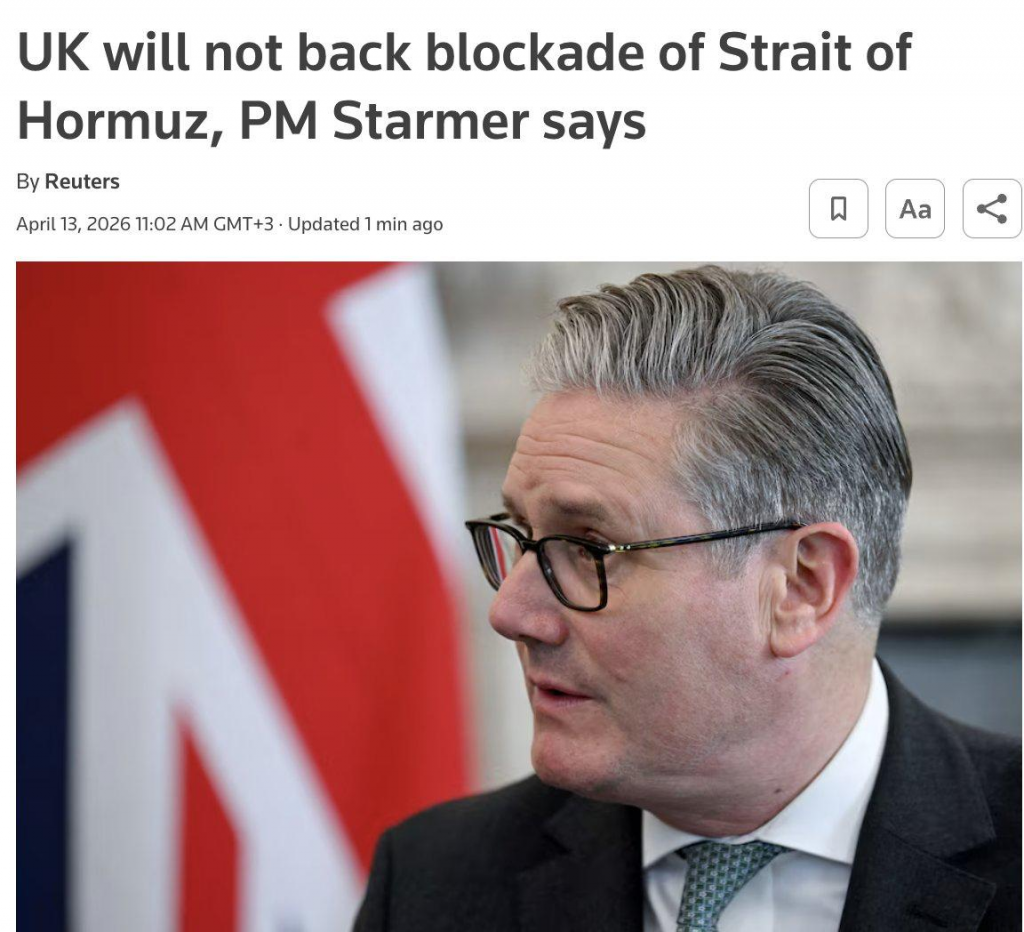
Britain joined in the ‘Refusal Brigade’ following Prime Minister Sir Kier Starmer distancing the UK from supporting the blockade, according to Sky News, who said that Britain will not be dragged into the Iranian war whatever the pressure.
Turkey also ruled themselves out when Foreign Minister Hakan Fidan said the Strait should be reopened through ‘peaceful means’ and warned ‘any military approach to securing the waterway would be very complicated,’ adding that no country wants to be part of the war waged with Iran and urged diplomatic solutions.
French President Emmanuel Macron said France and the UK would convene a conference with other countries willing to contribute to a peaceful multinational mission to restore the freedom of navigation in the Strait, stating the initiative would involve a strictly defensive mission, separate from the warring parties, which would be deployed as soon as the conditions allowed.
Norway and Canada subsequently refused support in the Strait, but France was reportedly undecided, China and the Netherlands hadn’t issued any response, and there was no confirmation from South Korea, which made it appear the Trump administration was becoming increasingly isolated.
On Monday evening, Britain’s Ministry of Defence reported they were deploying additional military planners to the Middle East as the UK continued to explore efforts to make the Strait of Hormuz accessible, so additional air defences had been supplied, including the Lightweight Multirole Launcher in Bahrain, and the Rapid Sentry and ORCUS systems in Kuwait.
Possible Negotiations:
Regional countries were urgently trying to bring back the US and Iran to the negotiation table after talks in Islamabad ended without a deal, reported the WSJ, stating that despite firm rhetoric from both sides, the door to diplomacy remained open, with a possible round of second talks within days, while regional states were also working with Washington to extend the two-week ceasefire.
Pakistan, Egypt and Turkey were looking to continue talks with Iran and the United States in the coming days to bridge the remaining gaps and reach an agreement to end the war, reported Axios, and Pakistani Defence Minister Khawaja Asif told Al Mayadeen that a new round of talks between the US and Iran would begin soon, noting that on Sunday the Turkish and Egyptian Foreign Ministers both called the Pakistani Foreign Minister, then Araghchi and Witkoff respectively.
Defence Minister Khawaja Asif said there still remained a possibility of resuming talks and expressed optimism about ongoing talks, adding that a new round of negotiations were expected soon, noting that Islamabad was satisfied with the discussions so far and that no negative developments have emerged from them, reported Al Mayadeen.
According to CBS, a former Pakistani national security adviser reported that Pakistan was working to get the US and Iran back to the negotiating table after the first attempt in Islamabad failed, later adding that US and Iranian negotiation delegation leaders were continuing to engage with one another despite the failed negotiations, and an official reported there was forward motion on trying to reach an agreement.
Trump administration officials were discussing a possible second in-person meeting with Iran before the ceasefire ended, though plans remained uncertain, reported CNN, stating they were considering potential dates and locations, which include Geneva and Islamabad, while talks with regional mediators continued and Turkey also worked to bridge differences, but officials said they want to be ready to act quickly if progress was made and remained hopeful a diplomatic solution was possible, potentially extending the ceasefire to allow more time for talks.
Iranian Conversations:
Building up support for Iran with regional countries during the ceasefire, Iranian Foreign Minister Abbas Araghchi held a series of calls with different officials in order to discuss regional and international developments with counterparts.
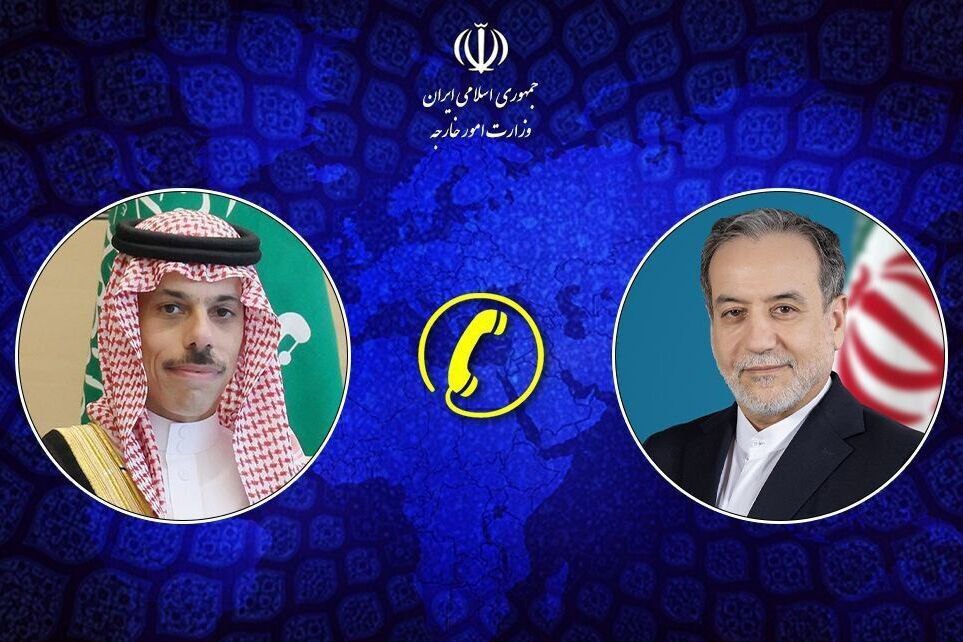
Saudi Arabia was one such conversation, as Araghchi made the second call to his counterpart Faisal bin Farhan since the start of the war was imposed on Iran, coming after a fresh round of talks mediated by Pakistan failed to conclude satisfactorily despite 21 hours of intensive discussions.
France later held a call with Araghchi, with the French Foreign Minister and Iran’s FM discussing the negotiations between Iran and America in Pakistan as well as developments.
During the evening, Araghchi held a call with Russian FM Sergey Lavrov to discuss the developments and the negotiations, reported Tasnim News and Fars News Agency, noting other calls had also been held with Qatari Prime Minister and Foreign Minister Mohammed bin Abdulrahman Al Thani, Omani Foreign Minister Badr al-Busaidi and Egyptian Foreign Minister Badr Abdel-Aati.
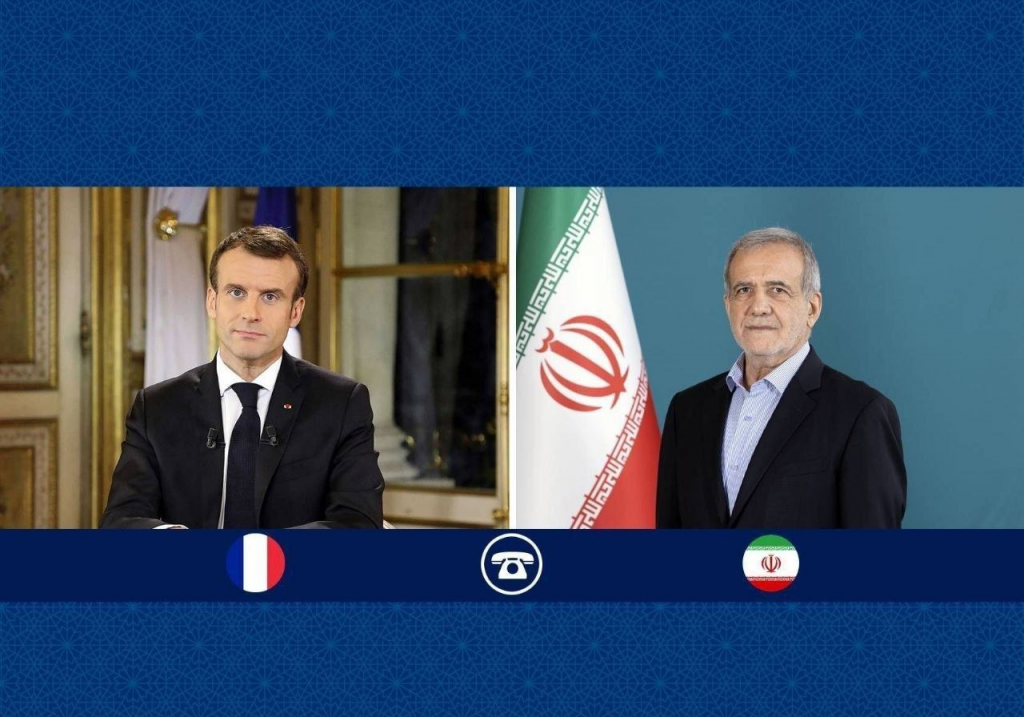
President Masoud Pezeshkian told President Emmanuel Macron in a call that Iran had clearly stated the conditions for a ceasefire and are committed to them, but the US’s excessive demands prevented an agreement, and threatening the Strait of Hormuz would have widespread consequences for the world.
Other News:
Prime Minister Benjamin Netanyahu said that he’d been briefed by US Vice President JD Vance in great detail, as the Trump administration does daily on the negotiation developments, adding that Vance conveyed the central issues for President Trump were the removal of enriched material and ensuring that there would be no enrichment in Iran for years to come, possibly even decades, while noting that the talks collapsed because Iran violated an agreement to open the Strait of Hormuz following the ceasefire.
Three of Israel’s major television networks, (Kan News, Channel 12, and Channel 13) have all reported the IDF was gearing up for renewed fighting with Iran following the lack of a breakthrough in the ceasefire talks in Islamabad.
Iran’s Ministry of Education reported that 278 students and 67 teachers were killed during the US and Israeli aggression, stating the attacks caused damage to or destroyed 933 schools, 54 administrative facilities, 17 cultural centres and 46 sports halls, according to both QudsN and Al-Mayadeen.
Turkish Foreign Minister Hakan Fidan said that there was currently a need for a sincere ceasefire on both sides, but Israel was always the factor and their disruptive role must always be taken into account, stating that both the Americans and Iranians had returned home from the negotiations, and believed that Iran would evaluate the proposal made by the Americans and give an appropriate response, said The Clash Report.
German Chancellor Friedrich Merz said that the failure of negotiations in Islamabad hadn’t come as a surprise and he didn’t have a great belief they would from the beginning, stating that the world will continue to feel the consequences of the war for a long time, even after its over, so the German government were preparing for a prolonged period of significant strain on the economy and private households.
Iran’s Deputy Interior Minister Ali Akbar Pourjamshidian said Trump’s threat to ‘destroy our civilisation’ was more a joke born of ignorance than a serious analysis, stating those who don’t understand Iran’s civilisation cannot grasp its depth, even if infrastructure is targeted, adding that when Iranians’ national pride is wounded, they rally in the streets to defend their country, and that even those with grievances against the system show fierce defence when faced with an external issue.
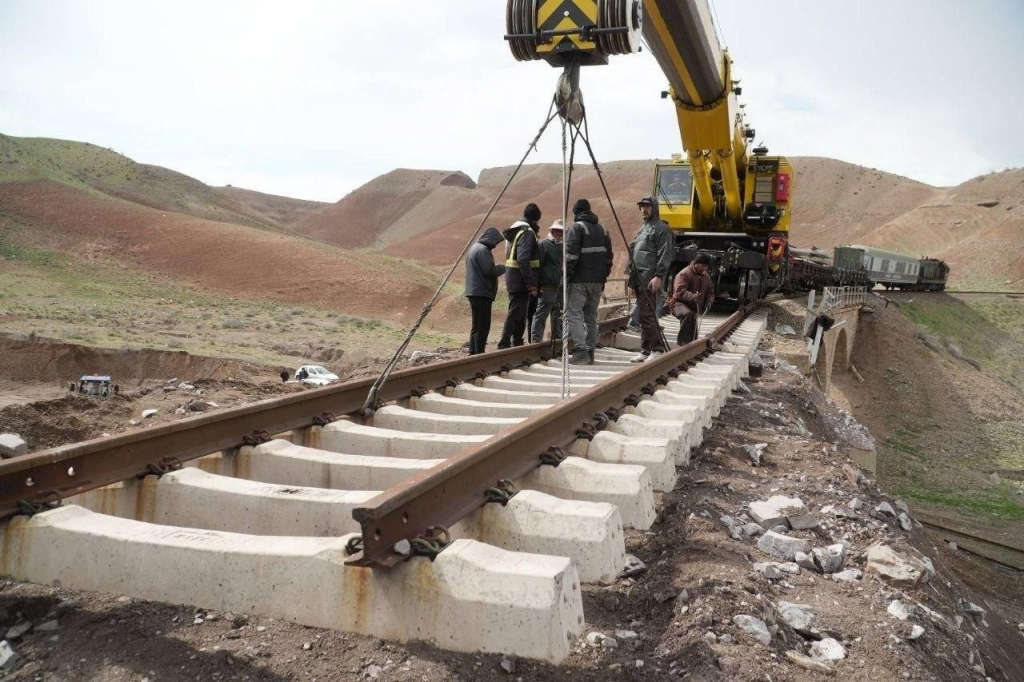
Within less than two days, authorities of Iran had restored railway lines between Qom, Tehran and Tabriz, allowing train services to resume, which were damaged following the US and Israeli coalitions airstrikes. The Tabriz-Tehran and Tabriz-Mashhad train services resumed within 4-5 days, Kashan Bridge was repaired within 72 hours and Qom bridge was repaired within 40 hours, reported CIG Telegram., as Tasnim News reported a total of 6 railway points that had been damaged were all now repaired and movement of trains had resumed on all routes.
Iran’s new Defence Minister Majid Ebn-e-Reza said Tehran is ready for any scenario, responding strongly and forcefully, ‘making enemies regret any aggressions.’
Deputy Speaker of Iran’s Parliament Ali Nikzad told Iranian State TV that the objective of the United States in Isfahan was to seize uranium, but they failed, while saying that Iran was prepared to demonstrate goodwill by diluting 450 kilograms of enriched uranium, not by handing it over, adding that in previous talks, it was agreed to establish a consortium to dilute uranium in participation of the United States and Saudi Arabia, but they backed out: “It even went as far as them proposing the creation of legal framework for the Strait of Hormuz in which the Americans would be part of it, but what do they have to do with the Strait?”
Israeli Channel 12 were allegedly told by a ‘Saudi Royal’ that there was no solution other than land entry into Iran by the US in a repeat of the overthrow of the Saddam Hussein regime in 2003, but this time there needed to be a successful, acceptable and secular alternative government on the Iranian Street, stating it would be better if it wasn’t Reza Pahlavi. “There is no other solution – they should treat this like the Saddam Hussein Regime and recreate the Bush administration’s experience, because the war has not achieved its results, and Iran is continuing with its nuclear program, while becoming more aggressive towards us, towards Israel, and towards the US and its interests in the region and the world.”
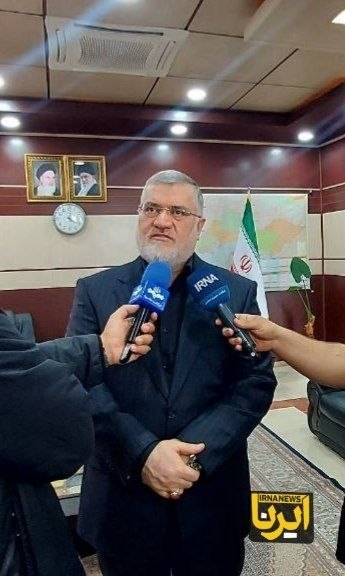
Tehran Governor Mohammad-Sadegh Motamedian said US and Israeli strikes constituted war crimes after 40,000 residential homes had been damaged in the province, while emergency services, schools and even UNESCO-listed historical sites had been hit, adding that there was international silence in the face of such crimes, and that Iran would document and pursue the crimes through international bodies, reported IRNA News.
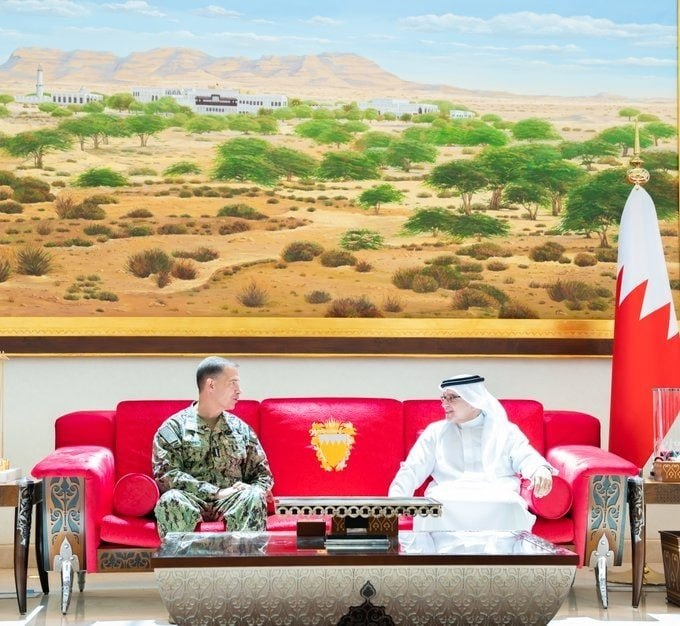
Bahrain’s Crown Prince Salman bin Hamad Al Khalifa, (also Deputy Supreme Commander of the Armed Forces & Prime Minister), met with US Central Command Chief Admiral Brad Cooper to discuss strengthening partnership in military and defence shields, where the Crown Prince highlighted the historic role of bilateral ties in deterring Iranian attacks, while the two also reviewed other regional developments.
Multiple Israeli channels began fearmongering around 7pm Israeli time, with Channel 14 reporting Israel were making preparations for an immediate renewal of the war with Iran, while Haaretz reported that Israel expected Iran to strike pre-emptively before midnight Israeli time, something Iran has not been known to do previously, while Kan News assessed the US and Iran were closer to renewed fighting than an agreement after the Americans briefed Israel that the gaps in negotiations remained ‘significant.’
Russia delivered a sharp warning to Israel over strikes near the Bushehr nuclear reactor in Iran, according to Israeli Channel 12, stating that Israel was ‘playing with fire’ and could lead to a ‘nuclear catastrophe,’ which comes after Moscow had repeatedly protested following an Israeli strike that landed close to Russian personnel, whose presence the IDF claimed they were ‘unaware of.’ Russia has since evacuated most of its staff from the plant. A senior official wrote to Jerusalem: “You are putting our people in danger – this is a dangerous game that could lead to a huge nuclear disaster with severe consequences for the Entire Middle East.”
According to Axios, the US demanded during the weekend talks in Islamabad that Iran freeze uranium enrichment for 20 years, but Iran countered with a shorter ‘single digit’ period, while the US also asked Iran to remove all highly enriched uranium from the country which Tehran countered with a monitored process of down-blending instead, and the nuclear issue was the main sticking point that prevented a deal. Pakistani, Egyptian and Turkish mediators were trying to bridge gaps before 21 April, and Turkish FM Fidan said an extension of 45-60 days could be considered to allow negotiations to continue.
Director of the International Energy Agency said: “We are losing 13 million barrels of oil per day due to the effects of the war in the Middle East – prices do not reflect the severity of the problem caused by the war.”
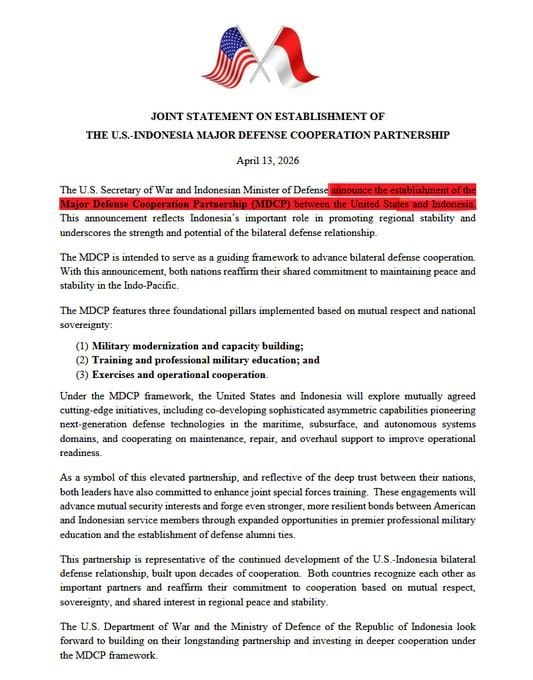
Following intense talks with Indonesia, the US Secretary of War Pete Hegseth met with Indonesian Defence Minister Sjafrie Sjamsoeddin at the Pentagon, where the two leaders agreed to elevate bilateral defence relationships to a Major Defence Cooperation Partnership which focused on military modernisation, training and professional military education, along with exercises and operational cooperation including the use of skies.
In the final post of the recap, Netanyahu addressed Israel, stating that year after year after year on National Holocaust Day he had pledged that Israel wouldn’t allow Iran to develop nuclear weapons, (while saying every week to US Presidents that Iran was just two weeks away from gaining a nuclear weapon), adding that as Prime Minister of Israel, he wouldn’t let another Holocaust happen, that Israel have dealt the Iranian regime the hardest blow in history and the regime is weaker than either because most of its military assets had been destroyed.