 AJ
AJ
Israeli airstrikes on Iran hit the gas administration building and a gas reduction station on Isfahan’s Kaveh Street, causing damage to the facilities, while a gas pipeline that serves the Khorramshahr power plant was hit in a separate attack, officials reported to Fars News, as the Khorramshahr governor stated that a projectile struck outside the gas line station and no casualties were reported.
Points of negotiation from the US had been received by the Iranians according to a senior Iranian Foreign Ministry Official, telling CBS that the terms were under review.
CBS stated that a senior Iranian official told them the US had sent a message via mediators, with Tehran currently reviewing the proposals, adding that the development pointed to ongoing indirect diplomacy, despite denials on Monday from Iranian officials that talks were taking place.
Iranian officials are concerned that any US-brokered ceasefire would be a trap, WSJ reported citing Iranian and Arab sources, noting that Tehran worried any face-to-face negotiations could lead to an assassination attempt on the Parliamentary Speaker, one of the few senior Iranian leaders who had survived Israeli strikes, but officials also suspect Trump’s announcement of postponing strikes on energy may be aimed at dampening oil prices before resuming attacks.
Wall Street Journal tried to push Israeli media narratives by claiming Gulf states were increasingly moving closer to potential direct involvement in the conflict, as Iranian strikes on critical energy infrastructure forced a shift away from their previously cautious stance, noting that Saudi Arabia had allowed the use of key air bases, while the UAE had taken internal measures against Iranian-linked networks.
Qatari government spokesman Majed Al-Ansari denied reports that a proposed US-Iran deal would include closing the giant airbase at Al Udeid in Qatar: “If anything, the current crisis will strengthen the existing partnership that Qatar and the Gulf Cooperation Council states have, including with the US.”
Despite the shift, Gulf leaders remain reluctant to fully enter the war, fearing both Iranian retaliation and uncertainty over the long-term commitment of the United States, but continued strikes on refineries, shipping routes, airports, etc., were eroding hesitation.
Iranian oil was being offered to Indian refiners at a premium of $6-$8 per barrel above Brent crude due to demand driven by urgency and proximity, reported Reuters, adding that Indian refiners were weighing their options and purchases amid logistical and payment challenges, including Iran’s exclusion from the SWIFT system, noting that India hadn’t imported Iranian crude since 2019 due to US sanctions, but the current shortfall meant an urgency for replenishment.
Bloomberg reported that Israeli strikes on Iran’s giant South Pars gas field last week had halted natural gas flows to Turkey, which was around 14% of its natural gas from Iran last year, but Ankara was still continuing to receive gas from Russia and Azerbaijan and still had its own stockpiles, but this was later denied by Turkish officials.
South Korea’s Prime Minister Kim Min-seok cancelled a planned visit to China, citing the need to stay in the country to address the economic and livelihood impact of the Iranian conflict.
Head of the Iranian National Emergency Organization reported that 1,563 Iranians under the age of 18 had been killed and 3,794 women had been killed since the begining of the conflict.
US and Israel will continue to strike Iranian military facilities and naval sites during the five day pause on by Trump, which US officials confirmed only applies to Iranian energy infrastructure, according to Semafor.
Six people were lightly injured following an Iranian ballistic missile attack early on Tuesday morning in Tel Aviv, as footage showed damage to areas from cluster munitions, while blast waves damaged apartments and buildings, as later reports suggested a new type of warhead had been used, deploying 3-4 cluster munitions that had at least 100kg of explosives each.
Bahrain’s Ministry of Interior said on Tuesday morning that the Civil Defence extinguished a fire in a facility of a company that had been damaged as a result of an Iranian attack, and relevant procedures were taken at the site.
Iranian Parliament Speaker Mohammad Bagher Ghalibaf could be seen as a possible negotiating partner and a potential future leader in Iran by the Trump administration, reported Politico, adding that officials said the idea was still being tested, with significant scepticism over whether Tehran would cooperate, while some leaders described him as a ‘hot option.’
At least six Kurdish Peshmerga fighters were killed and 22 wounded in a rocket attack on their base in the north of Erbil in Iraq’s Kurdistan region.
A Chinese-linked oil tanker transited the Strait of Hormuz using a route close to Iran’s coastline reflecting a broader pattern in which ships tied to China were among the few able to pass through the Strait with Tehran’s tacit approval or coordination, while some vessels are also reportedly using alternative or Iran-designated corridors within its territorial waters to reduce risk, further underscoring Tehran’s leverage over one of the world’s most critical energy chokepoints.
Kremlin spokesperson Dmitry Peskov said Russia would be highly concerned if the conflict involving Iran spread into the Caspian Sea, describing such a development as a serious escalation in a strategically important region shared by several countries, including Russia, with implications for regional security, energy and trade.
Iran’s police claimed 466 individuals were accused of undermining security and operating online against the state have been identified and arrested in recent days, with the authorities claiming the suspects were involved in spreading fear, disrupting public opinion, promoting narratives in favour of hostile actors, and organising activities deemed harmful to national security.
Pakistan pushed to mediate talks to end the war, with its army chief Field Marshall Asim Munir holding calls with Trump, according to Bloomberg citing people familiar with the matter, stating that Munir spoke with Trump as Pakistan positions Islamabad as a potential location for negotiations.
Pakistani Prime Minister Shehbaz Sharif also said that his country was ready to facilitate meaningful and conclusive talks to end the war: “Subject to concurrence by the US and Iran, Pakistan stands ready and honoured to be the host to facilitate meaningful and conclusive talks for a comprehensive settlement of the ongoing conflict,” he wrote on X.
Lebanese Foreign Ministry’s Yessef Rajji summoned Lebanon’s Ambassador to Iran, Ahmad Swaidan, for consultations, following what the Lebanese state described as Iran’s violation of diplomatic norms and established protocols between the two countries, later removing the accreditation and granting the ambassador until Sunday to leave Lebanon.
Israel’s Foreign Minister Gideon Sa’ar welcomed the Lebanese Foreign Ministry’s decision to expel the designated Iranian ambassador, calling it a justified and necessary step against a country responsible for violating Lebanon’s sovereignty through its indirect occupation with Hezbollah, and was dragging Lebanon into the war, as Sa’ar also called on the Lebanese government to take practical steps against Hezbollah, noting that ministers from the organisation still served in the government.
An Israeli official told CNN that a deal to end the war with Iran didn’t appear tangible right now, reporting Tehran didn’t appear to be in any concession mode, suggesting diplomatic efforts may be aimed at buying time rather than reaching a settlement, but while multiple countries are attempting to mediate between Washington and Tehran, there was no concrete proposal on the table.
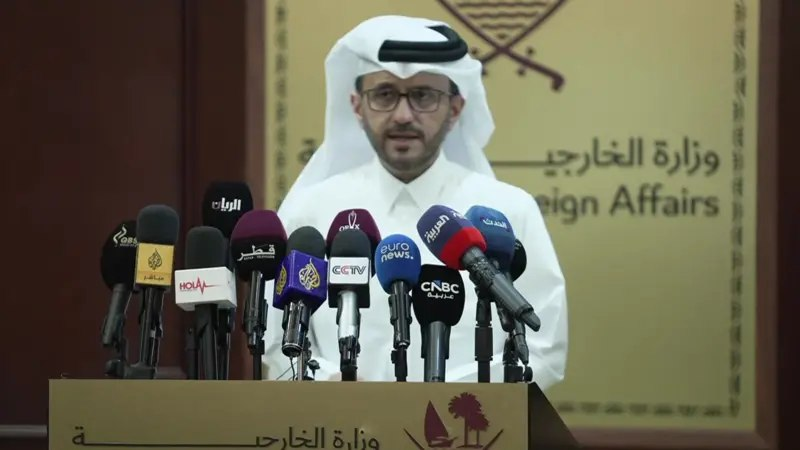
Qatar’s Foreign Ministry spokesman Majid Al-Ansari said the country wasn’t involved in mediating between the US and Iran, despite the reports of emerging talks, noting that the focus was ending attacks on Qatar and defending the country, adding that Qatar supports a diplomatic solution but is not party to negotiations.
Al-Ansari also confirmed there had been no incoming missiles or drones aimed at Qatar since last Thursday, though they were ‘still only in the eye of the storm,’ stating that over 200 drones attacks targeted Qatar, with 90% successfully intercepted.
Iran appointed former IRGC Commander Mohammad Bagher Zolghadr as Secretary of the Supreme National Council, replacing Ali Larijani who was killed in Israeli strikes earlier this month. Zolghadr is a hardline Revolutionary Guards veteran with close ties to the Basij paramilitary force, was appointed to his previous role by the late Supreme Leader Ali Khamenei in 2021, and was said to have received the approval for his new appointment from new Supreme Leader Mojtaba Khamenei.
Japanese Prime Minister Sanae Takaichi announced that the government was to begin releasing strategic stockpiles of oil products this week to counter rising fuel prices driven by the conflict in the Middle East, and the country had already implemented subsidies as well as releasing some private stockpiles.
German President Frank-Walter Steinmeier said the war in Iran violated international criminal law, appearing to criticise his own government for not being clearer in its condemnation: “The justification based on an imminent attack on the US does not hold water,” he said, describing the war as a “politically disastrous mistake.”
UAE’s Ministry of Defence said they had intercepted five ballistic missiles and 16 drones launched from Iran on Tuesday, noting that since February 28, air defences had intercepted a total of 357 ballistic missiles, 15 cruise missiles and 1,806 drones, and the the ministry said it remained fully prepared and ready to deal with any threats.
Commander of Iran’s Khatam Al-Anbiya Central Headquarters Major General Ali Abdollahi Allabadi said the ‘enemy’ launched an intense war aiming to partition and consume the nation, hoping that the death of the Supreme Leader and other senior officials at a gathering would help the country collapse within 48 hours, but instead, over 25 days, Iran has forced ‘the aggressors into defeat and is advancing toward final victory.’
Iran begun charging transit fees on commercial vessels passing through the Strait, demanding payments of up to $2 million per voyage on an ad hoc basis, Bloomberg reported, adding that some vessels had made the payment, though the mechanism remained unclear and didn’t appear to be systematic.
US Secretary of State Marco Rubio plans to travel to France on Friday to discuss the war and other global crises with top diplomats from the Group of G7 nations, according to the US State Department, noting that the previous scheduled meeting to be held outside Versailles will also address Russia’s war in Ukraine and other threats around the world.
Bahrain requested a session of the UN Human Rights Council on behalf of the six Gulf Cooperation Council states and Jordan which will be debated on Wednesday to discuss Iran’s military strikes on Gulf countries and their impacts on civilians, while separately, Iran, China and Cuba have submitted a request for an urgent debate to be entitled ‘protection of children and educational institutions in international armed conflicts,’ which was considered by the council bureau on Tuesday evening.
More than 100 gas stations across Victoria, Australia, had ran out of petrol on Tuesday, with 83 lacking diesel, due to a large surge in demand sparked by the war, as Victorian Energy Minister Lily D’Ambrosio said demand spiked by up to 400% in some areas, though fuel supplies to the country remained unaffected, while Federal Energy Minister Chris Bowen warned against panic buying.
Debris from an intercepted missile fell on a mobile home in an unrecognised Bedouin community in the Negev Desert on Tuesday, injuring four people – medics reported a man in his 40s in moderate condition, while three others, including two infants and a woman in her 40s had light injuries.
Saudi Crown Price Mohammed bin Salman has urged Trump to continue the war, calling it an historic opportunity to remake the region, pushing for attacks on Iran’s energy infrastructure and a ground operation to seize Kharg Island – a step Trump has seriously considered, though it would be immensely dangerous – while Saudi officials fear that if the war ends prematurely, Iran could periodically close the Strait, crippling the Gulf economies, but also worried a failed Iranian state could unleash even greater instability.
QatarEnergy has declared force majeure on some liquified natural gas supply contracts following the attacks that reduced output of condensate and LPG, as the company told Bloomberg it continues to assess the full impact of the disruptions.
British forces reportedly shot down 14 drones overnight from March 23 to March 24 at a coalition base in Erbil, northern Iraq, the largest number in recent weeks – members of the RAF Regiment used Rapid Sentry air defence systems to protect the base, which has come under repeated attacks from Iranian drones for the past three weeks, as Downing Street revealed British pilots had flown almost 900 hours defending the UK and its allies in the region over the past four weeks.
Indian Prime Minister Narendra Modi said he spoke with Trump on the Iran conflict, describing the call as a ‘useful exchange of views,’ stressing that India ‘supports de-escalation and restoration of peace at the earliest’ and emphasised that the Strait must be ‘open, secure and accessible.’
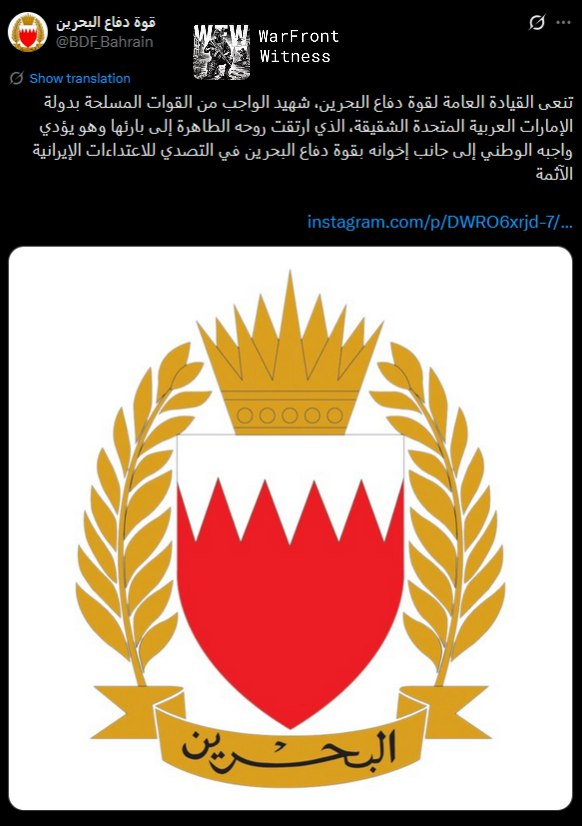
Bahrain Defence Ministry reported that a soldier was killed while responding to Iranian attacks, while several Bahraini and Emirati troops were wounded, later confirming that a Moroccan civilian contractor working in the UAE armed forces was killed in an Iranian missile attack on Bahrain, while five UAE defence personnel were also wounded in the attack.
Saraya Awliya al-Dam Military Spokesman al-Jaafari condemned the killing of Popular Mobilisation Forces fighters in a US-Israeli airstrike on the Anbar Operations Headquarters, questioning the message behind a separate US strike on a guesthouse belonging to the head of the PMF, calling it an insult to all Iraqi security forces and a threat to resistance fighters, while also accusing the Iraqi Security Media Cell of issuing statements designed to turn public opinion against resistance factions, effectively serving American interests, and also expressed frustration over the security restrictions in Baghdad and its outskirts, asking why such measures target resistance fighters while US and Israeli drones operate freely in Iraqi skies.
US airstrikes on Tuesday evening targeted the headquarters of the 31st Brigade of the Popular Mobilization Forces at the Sinniyah base in the Baiji district, Salah al-Din province, northern Iraq.
Talks have been proposed by the United States between VP JD Vance and Parliament Speaker Ghalibaf, with Turkey acting as an intermediary, conveyed as part of broader efforts to open a diplomatic channel, but Iran had yet to respond to the US proposal, and Ghalibaf had said no negotiations had been held with Washington, stopping short of ruling out third-party mediation.
Amazon’s cloud unit was experiencing service disruptions in Bahrain related to drone activity in the early hours of Tuesday morning, three weeks after drone strikes had damaged three of the company’s data centres in the Gulf region, but Amazon declined to elaborate on whether drone activity meant a direct hit.
Iran has hardened their negotiating position, Reuters reported, with Tehran demanding major concessions before entering any serious talks, because Iran is seeking a formal end to the conflict, guarantees against future military strikes, compensation for wartime damage, and control over the Strait, while also refusing any limits on its ballistic program, noting the IRGC had increased its influence over decision-making, further reducing flexibility in Tehran’s stance and making compromise less likely.
Israel launched around six strikes against Tabriz on Tuesday afternoon, with one strike allegedly hitting the Rabe Rashidi Complex.
Parliament Speaker Ghalibaf said that Iran were aware of what is happening in the ‘paper oil market,’ including the firms hired to ‘influence futures,’ but said they would see if that could turn actual fuel at the pump, ‘or maybe even print gas molecules,’ he added, criticising market dynamics and external pressure on energy prices.
Chinese Foreign Minister Wang Yi spoke with Araghchi, who said Iran is committed to a ‘comprehensive ceasefire, not just a temporary one, adding: “Hormuz is open to all, and ships can pass safely, but countries currently at war are not being considered,” stressing that ‘talking is always better than fighting,’ while urging all parties to ‘seize every opportunity and window of opportunity for peace and initiate the peace process as soon as possible.’
82,417 ‘civilian units’ across Iran have been damaged by airstrikes since the start of the war, reported the President of the Iranian Red Crescent Pirhossein Kolivand, noting that damage was also caused to 281 hospitals, clinics and pharmacies.
Lebanese’ Health Ministry has announced that 1,072 people had been killed and 2,966 wounded as a result of Israeli airstrikes since March 2.
Central Command stated that the number of US service members injured in Iran had risen to approximately 290, up from around 200 last week, noting that 225 had already returned to duty, while ten remained seriously wounded, adding that thirteen US troops had been killed in action to date.
Missiles were intercepted over Lebanon, with explosions heard north of Beirut in the Keserwan district, but the Lebanese military lacks air defences, so its unclear exactly what the intended target was (possibly the US Embassy) or how the missile was intercepted, however state media did report that interceptor missiles had allegedly caused the explosions, adding that debris had fallen in the town of Faitroun and the mountain village of Baskinta causing light injuries, and two Lebanese security sources claimed a foreign naval vessel carried out the interception.
At least three people were injured, including one moderately, following an Iranian cluster munition impacting around the city of Bnei Brak, first responders said, noting that several more bomblets impacted Petah Tikva with no reported injuries, as reports suggested Iran launched 2 missiles, one intercepted, but the other was a cluster munition that had released its payload before falling.
According to Al Arabiya, a Saudi source denied claims the Kingdom’s leadership preferred to prolong the war, pushing back on reports about its stance toward continued military action, which comes after reported cited US officials suggesting Saudi Arabia encouraged sustained strikes against Iran in order to take out their ballistic missile capabilities.
Iran’s Atomic Energy Organisation said the Bushehr nuclear power plant site was attacked again on Tuesday, in what it described as a continuation of US-Israeli strikes, noting that no damage or casualties were reported, as the agency condemned the attacks on peaceful nuclear facilities, warning that they could have ‘dangerous and irreparable consequences’ for regional security, particularly for countries along the Gulf.
Iraq’s Ministerial National Security Council has authorised the Popular Mobilisation Forces and other security agencies to exercise the right of response and self-defence against military attacks targeting their positions, condemning the repeated attacks on PMF headquarters and Peshmerga posts as violations of Iraqi sovereignty, and instructed the Foreign Ministry to file formal protests with the UN Security Council. The council also ordered the summoning of the US chargé d’affaires and the Iranian ambassador to receive official protest notes over attacks that hit PMF positions in Anbar and other areas, as well as Peshmerga sites in Erbil.
French President Emmanuel Macron said he spoke with Iranian President Masoud Pezeshkian, stressing the need to end attacks in the region, protect civilian and energy infrastructure, and restore freedom of navigation in the Strait of Hormuz, urging Iran to engage in good faith negotiations in its nuclear and missile programmes and calling for the release of French nationals Cécile Kohler and Jacques Paris.
Pope Leo XIV renewed his appeal for a ceasefire in the Middle East, warning that ‘hatred is increasing, violence is worsening,’ as the Pope spoke to reporters outside his residence in Castel Gandolfo, the Pontiff also said more than a million people had been displaced and many others killed, adding: ‘We want to pray for peace, but I invite all authorities to truly work through dialogue to resolve this problem.”
Kuwait’s Directorate General of Civil Aviation took to X to state drones targeted a fuel tank at Kuwait International Airport, causing a fire at the site, the aviation authority said, stating that there wasn’t any damage according to initial reports, as well as no casualties reported, as emergency teams responded to the incident.