 AJ
AJ
Today’s US/Israel Iran war update is a countdown to the final moments a deal was brokered, as well as the immediate comments that were made afterward. There may be one more recap to come, as the rest of the world wakes up on Wednesday 8th April to a ceasefire in the Middle East.
Israel approved a list of energy and infrastructure sites in Iran in preparation for a contingency scenario in case US-Iran talks failed, two Israeli sources told CNN: “Israel is awaiting Trump’s decision on the next steps, but we have additional plans for the upcoming weeks pending on American green light,’ one of the officials said.
Vice President JD Vance was on standby to join negotiations with Iran if backchannel talks were to progress, POITICO reported on Tuesday morning, noting that discussions were being led by Steve Witkoff and Jared Kushner, with Vance expected to step in if enough progress is made, though it remained unclear at the time what Iran would need to offer, as Vance remained involved behind the scenes and in constant contact with intermediaries like Pakistan.
Britain was looking to distance itself from President Trump’s decision to target bridges and infrastructure, stating that Britain would not allow the US to use RAF bases for strikes on Iranian bridges or power plants, according to The i Paper, stating UK officials had argued such attacks on civilian infrastructure could amount to a potential war crime, and any US request to use British bases for this purpose would be refused.
Japan also sought talks with both Iran’s President Masoud Pezeshkian and US President Trump to ease tensions in the Strait of Hormuz, according to Bloomberg, while urging communications and maritime safety, noting that as US pressure mounts ahead of the deadline for strikes on civilian infrastructure, Japan was seeking diplomacy and mediation, coordinating with Iran directly and regional partners, including Pakistan.
President Pezeshkian took to X during the day on Tuesday, saying that more than 14 million proud Iranians had so far registered to sacrifice their lives to defend Iran: “I too have been, am, and will remain devoted to giving my life for Iran,” he added.
Qatar’s Foreign Ministry Spokesperson Majed al-Ansari said that if left unchecked, the escalation would get everyone into a situation where it cannot be controlled and were already close to that point, adding that there were no winners in the continuation of the war, and the net losers were expanding every day.
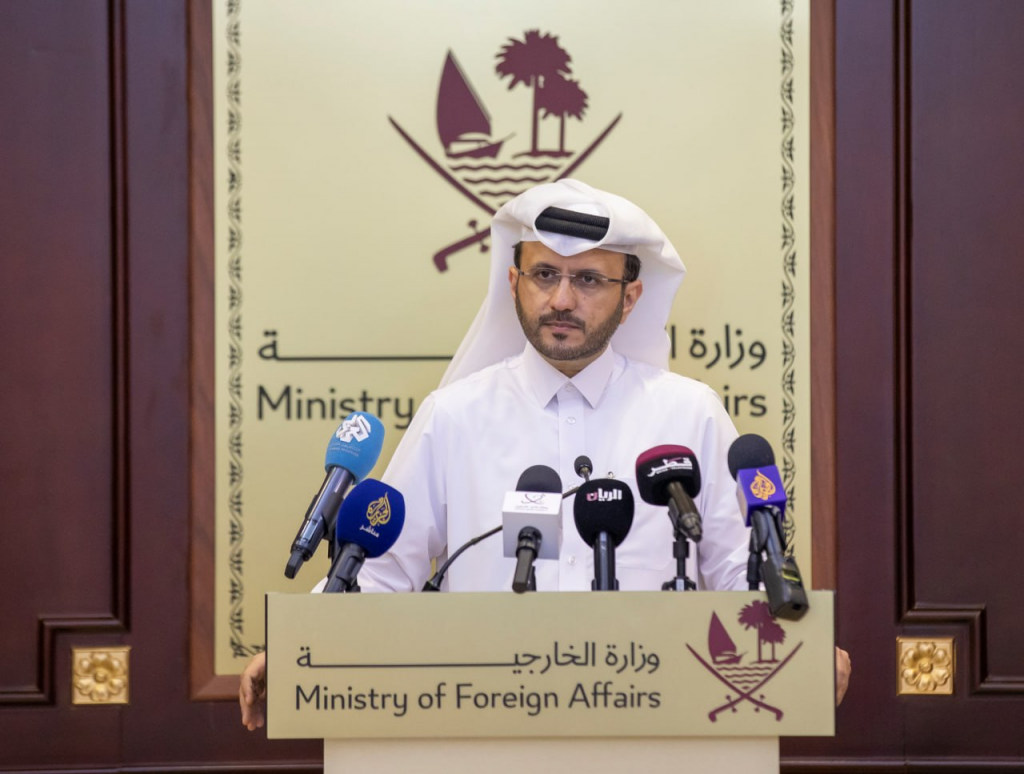
Al-Ansari later said that Qatari Emir Tamim bin Hamad Al Thani had held meetings and contacts with international leaders to coordinate on regional challenges, which included participation in an unscheduled UK-led ministerial meeting on the Strait of Hormuz, as Doha stressed it currently plays no mediation role as it is focused on its own defence, urging Iran to stop violations and respect sovereignty, while fully rejecting Iranian attacks on regional countries, including its own, and said the security of the Strait of Hormuz is an international responsibility tied to global economic stability.
French Foreign Minister Jean-Noël Barrot warned attacks on civilian and energy infrastructure were barred by the rules of war and would trigger reprisals form Iran, dragging the region and world economy into a vicious circle, noting that fuel prices were already surging and further strikes would worsen the situation.
Guido Crosetto, the Defence Minister for Italy, said on Tuesday that the Iran war put the US global leadership at risk and expressed concern over the ‘madness’ of nuclear escalation, warning that the conflict could take a worse turn, recalling the US atomic bombings of Japan in 1945.
Iranian Foreign Ministry official Ali Safari said Tehran had submitted its responses to mediators on Monday, including guarantees for safe passage of ships through the Strait of Hormuz, a comprehensive solution to the war across all fronts, and a complete cessation of US and Israeli attacks, noting that on the nuclear issue, Iran cannot negotiate under war conditions, no agreement had been reached so far, and the ‘ball is in the American court.’
Spokesman for Iran’s National Security and Foreign Policy Committee Ebrahim Rezaei told Tasnim News that Iran would not allow any ‘enemy ship’ to pass through the Strait of Hormuz: “The committee is currently discussing a strategic bill to protect the security of the Strait of Hormuz and the Gulf,” Rezaei said, stating that the history of the Strait would be divided into ‘before and after aggression against Iran,’ and that Iran would manage ships according to its own laws, in cooperation and coordination with the Sultanate of Oman.
Pressure was still mounting as the Wall Street Journal reported doubts by negotiators that Iran would meet Trump’s deadline to reopen the Strait of Hormuz by 8pm EST, increasing the likelihood of US strikes on infrastructure, stating Iranian officials had told mediators they expected the US and Israel to continue military action even if talks progressed, citing past concerns, as JD Vance, Steve Witkoff and Jared Kushner led diplomatic talks with Egypt Turkey and Pakistan relating messages, while decisions in Tehran were routed through the Supreme National Security Council and IRGC Chief Ahmed Vahidi.
An unannounced unscheduled meeting of military planners from more than three dozen countries, excluding the United States, met in London on Tuesday to discuss options for securing international shipping through the Strait of Hormuz, reported NYT, stating the meeting, which was organised by Britan, was primarily focused on steps that could be taken after the war.
By afternoon on Tuesday, Reuters had reported Iran had rejected any proposal for a temporary ceasefire, instead seeking a permanent end to the war, adding that Iran was worried about the progress of negotiations because of previous bad acts and bad faith shown by the USA and Israel.
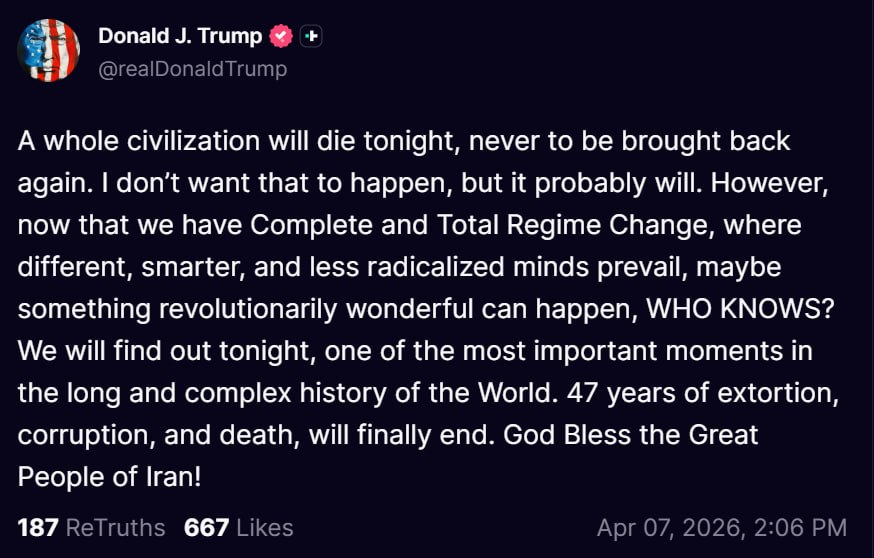
At around 8am Washington time (3pm Israel time), approximately 12 hours to the deadline, Trump took to Truth Social: “A whole civilisation will die tonight, never to be brought back again. I don’t want that to happen, but it probably will. However, now that we have Complete and Total Regime Change, where different, smarter, and less radicalised minds prevail, maybe something revolutionarily wonderful can happen, WHO KNOWS? We will find out tonight, one of the most important moments in the long and complex history of the world. 47 years of extortion, corruption, and death, will finally end. God Bless the Great People of Iran!”
Vance said soon after that the US was confident a deal could be reached by 8 o’clock Eastern Time, stating he hoped they’d make the right response: “They’ve got to know we’ve got tools in our toolkit that we so far haven’t decided to use. The President of the United States can decide to use them, and he will decide to use them if the Iranians don’t change their course of conduct.”
Trump threatened to wipe out a ‘whole civilisation’ as the US military struck targets on Iran’s Kharg Island oil hub, ramping up pressure to reopen the Strait of Hormuz, reported NYT, stating US and Israel had stepped up attacks to force Tehran to open the waterway and agree to a ceasefire deal, according to US and Israeli officials.
Pakistan were still hopeful that negotiations could prevent further escalation, but a Pakistani official told Reuters that Pakistan would stand with Saudi Arabia under their defence pact if the conflict escalated.
Iranians began forming human chains on bridges across Iran in rejection of President Trump’s threats and the day’s strikes by Israel which targeted bridges and railway infrastructure, with footage showing chains from the White Bridge in Ahvaz, the old bridge in Dezful, and a bridge in Ilam, as well as in front of the Kazeroon Combined Cycle Power Plant, which Trump later called “an illegal act,” even though participation was completely voluntary.
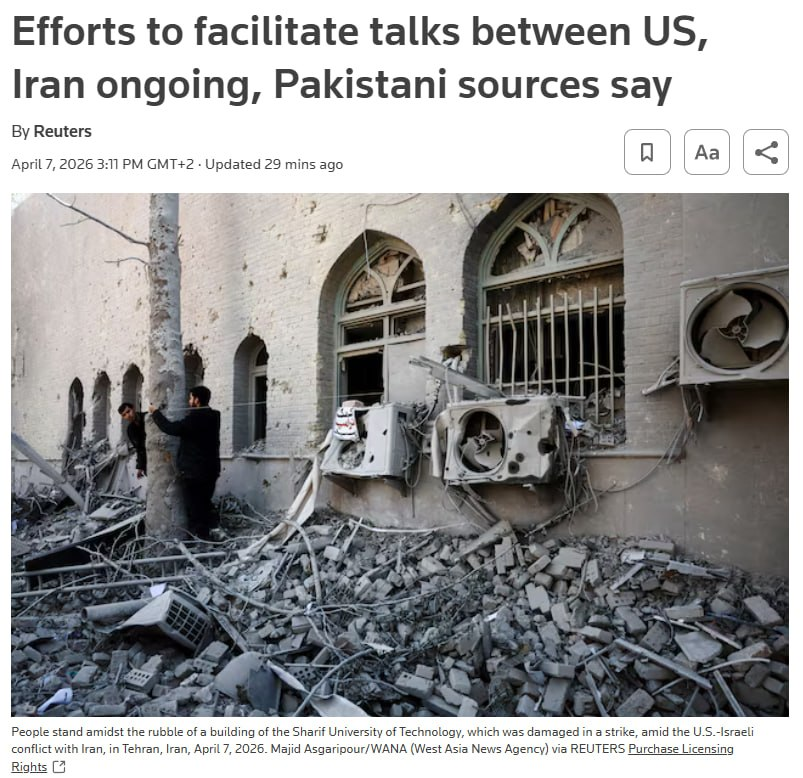
Pakistani efforts to broker a deal were continuing, reported Reuters, however, Iran’s recent strike on industrial sites linked to US companies in Saudi Arabia’s Jubail City had put negotiations at risk as Pakistan could be dragged into the conflict in case of a Saudi retaliation due to its defence pact with Riyadh, as a Pakistani source noted Iran was ‘walking on thin ice’ and that the next three to four hours are critical for the future of dialogue.
Israeli Prime Minister Benjamin Netanyahu went on national Israeli TV to proudly boast that Israel were crushing the ‘Iranian terror regime’ with increasing force, by destroying transport planes and dozens of helicopters on Monday, as well as railways and bridges used by the Revolutionary Guards on Tuesday.
“This is the main point: these actions which I approved together with the Defence Minister are not intended to attack the Iranian people – on the contrary, they are meant to weaken and crush the regime of terror that has oppressed them for 47 years – this is no longer the same Iran, nor is it the same Israel, we are changing the balance of power from extreme to the other,” Netanyahu said.
Severe threats by President Trump against Iran, along with growing pressure to find an exit from the conflict, had raised concerns that a volatile outcome would include nuclear weapons, according to a report by The Guardian, stating that in such a scenario, a military aide would present the ‘nuclear football,’ containing strike options and authorisation codes to Trump, and the only way to halt such an order would be if those in the chain of command judged it to be illegal.
Bahrain at this point were still looking to set a vote at the UN Security Council for a resolution regarding the Strait of Hormuz, which has been softened from calling for military force against Iran to instead urging countries with key interests to coordinate defensive efforts to keep the waterway open.
Meanwhile, the US and Israel were intensifying attacks on Iran to force them to reopen the Strait of Hormuz and reach a ceasefire deal, reported the NYT, citing US and Israeli officials.
Alerts started coming from various ministries in relation to the scheduled attack at 8pm (ET), with India’s Ministry of External Affairs urging Indians in Iran to shelter in place, advising them to stay indoors for 48 hours, avoiding electrical and military installations, which was followed soon after by a security alert from the US State Department noting that the US Embassy in Manana had directed all US government employees to shelter in place. Kuwait’s Interior Ministry also advised citizens and residents to remain at home between midnight and 6am as a ‘precautionary measure.’ The Spanish Embassy in Qatar later urged Spanish citizens to stockpile food, water, and medication.
President Trump told Fox News that 8pm was happening: “If we get to that point, there is going to be an attack like they have not seen,” he said, adding: “If negotiations move forward today and there is something concrete, the deadline could change, but at this hour we’re moving forward with the plans that we have.”
IDF Chief of Staff Eyal Zamir said that Israel were approaching a strategic crossroads in the joint campaign against Iran, stating that so far, they’d achieved significant accomplishments, also in relation to the objectives they set upon launching the operation, adding that they would continue to act with determination and deepen the blows to the regime.
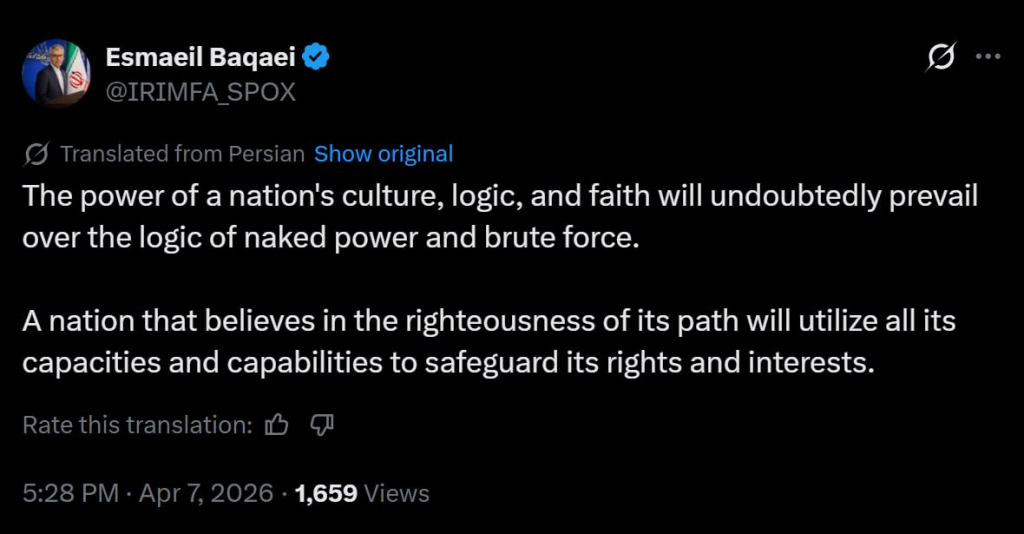
Foreign Ministry Spokesman for Iran, Esmaeil Baghaei, said the power of a nation’s culture, logic and faith would undoubtedly prevail over the logic of naked power and brute force – a nation that believes in the righteousness of its path will utilise its capacities and capabilities to safeguard its rights and interests.
“Iran would be wise to take President Trump at his word,” wrote the Senate Republicans’ official X account: “They can choose the easy way or the hard way.”
US B-52 strategic bombers took off from RAF Fairford in the UK at 4:01pm local time, which would mean they’d reach Iran around the time of President Trump’s deadline.
Vice President Vance said in the afternoon that the United States had fundamentally completed its military objectives in Iran and that the nature of the war’s conclusion was now down to Tehran, outlining that either Iran became a normal country that no longer funds terrorism and re-joins the global system of commerce, or continuing to face a very bad economic situation if it refuses to come to the table. Vance also said that US military strikes on Kharg Island didn’t represent a change in strategy, stating that Defence Secretary Pete Hegseth and Joint Chiefs Chairman Dan Caine were spoken to about targets on the island, as US Trump’s deadline for Iran to reopen the Strait of Hormuz remained Tuesday at 8pm, Vance reiterated.
Israeli Army Radio and Israeli Channel 12 reported that the next 24 hours were crucial, because if Trump’s deadline expired without a deal, Israel would also take part in strikes, noting that the targets would be Iran’s national infrastructure, targets saved for the case that Tehran continues to refuse an agreement.
Claims began to surface from the NYT and WSJ that Iran had cut off direct communications with the United States following Trump’s threat on social media to destroy ‘a whole civilisation,’ though talks with ceasefire mediators did continue, according to Tasnim News, Tehran Times and Irib News, as Iran still sought to end the war on their own terms.
According to a senior Iranian security official, a failed US operation in Isfahan was the reason behind Trump’s recent threats, saying that the operation wasn’t related to the downed pilot rescue, that generals who warned against the risks were fired days beforehand, and that the US forces had to abandon equipment and flee the area.
Bahrain attended the UN Security Council to push its Bahraini-drafted resolution on the Strait of Hormuz, proposed on behalf of the Gulf Cooperation Council member states (except Oman) and Jordan, but permanent members Russia and China vetoed the measure. Bahrain’s FM al-Zayani expressed regret after the veto, saying the rejection undermined the council’s credibility and sent a wrong message to the world – that threats to international waterways can continue without decisive action.
Six Hours To Deadline:
Negotiations showed limited signs of progress ahead of Trump’s Tuesday night deadline, but officials said a breakthrough looked unlikely, noting Iran had submitted a counter-proposal that US officials viewed as a cautiously positive step, with ongoing talks focusing on confidence-building measures such as reopening the Strait of Hormuz and reducing tensions, adding that the President faced a critical decision of whether to proceed with military escalation or diplomacy, as members of his team were pushing for a last minute deal, reported Axios.
US officials also said Defence Secretary Hegseth’s portrayal of the war with Iran had been overly optimistic and risked misleading President Trump, reported WaPo, stating concerns included repeated claims of ‘complete control of Iranian skies’ and that ‘Iran had no air defences,’ despite Iran shooting down an F-15E with a shoulder-fired missile – a hit that Trump himself called ‘lucky.’ Intelligence assessments indicated more than half of Iran’s missile launchers remained intact and thousands of drones were still available, contradicting Hegseth’s assertions, leaving officials worried that Hegseth wasn’t speaking the truth to the President, leaving Trump to repeat misleading information in interviews.
UN Secretary-General António Guterres was ‘deeply troubled’ by statements suggesting an entire civilisation may bear the consequences of political and military decisions, his spokesman Stephane Dujarric said, and without naming President Trump, added: “There is no military objective that justifies the wholesale destruction of a society’s infrastructure or the deliberate infliction of suffering on a civilian population.”
An informed Iranian military source warned that if Trump made a mistake, Saudi Aramco facilities, the Yanbu oil complex and the Fujairah pipeline would be added to Iran’s target list, as the source added that Trump doesn’t realise that acting on his threats would lead to $200 per barrel oil prices in the coming days.
Iran later issued warnings for 5 bridges and crossings in Israel, UAE, and Saudi Arabia, including Railway Bridge 431 in Rishon Lezion and Yaron Railway Bridge in Tel Aviv, Sheikh Zayed Bridge in Abu Dhabi, along with the King Fahd Causeway and the Riyadh-Jeddah land corridor in Saudi Arabia, in response to bridges that had been targeted throughout the day by Israeli forces.
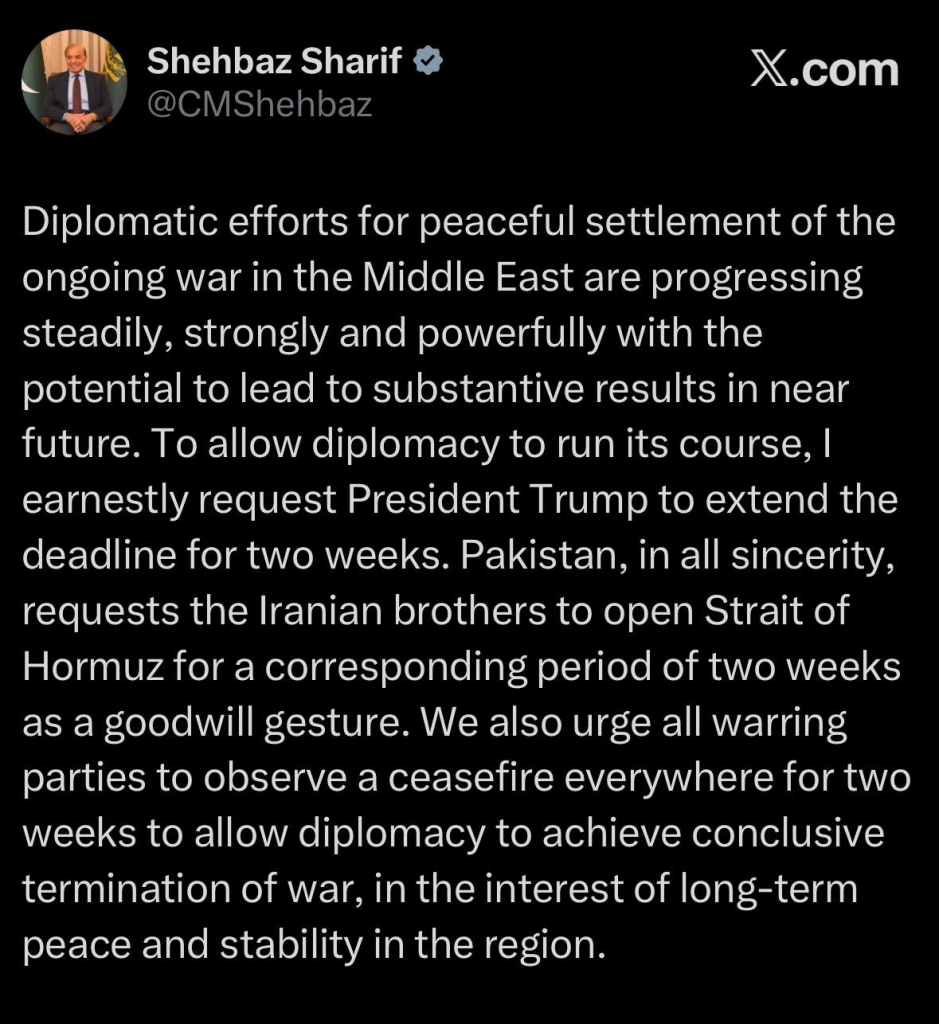
Pakistan PM Sharif asked Trump via X to extend his deadline for Iran in a desperate plea to prevent escalation: “Diplomatic efforts for peaceful settlement of the ongoing war in the Middle East are progressing steadily, strongly and powerfully with the potential to lead to substantive results in the near future. To allow diplomacy to run its course, I earnestly request President Trump to extend the deadline for two weeks,” he wrote, adding that: “We also urge all warring parties to observe a ceasefire everywhere for two weeks to allow diplomacy to achieve conclusive termination of the war, in the interest of long-term peace and stability in the region.”
With just four hours to go until deadline, a White House spokesperson told Axios that President Trump had been briefed on Pakistan’s proposal regarding Iran and would issue a response in the matter, later confirmed by Israeli Channels 12 and 14 too.
Italian Prime Minister Giorgia Meloni condemned Iran’s attacks on neighbours but stressed the distinction between the regime and ordinary civilians, saying that the Iranian people must not be made to pay for the actions of their government, following Trump’s warning that a ‘whole civilisation would die.’
White House Press Secretary Karoline Leavitt confirmed that President Trump had received the proposal for the ceasefire and said a response would follow soon.
French President Emmanuel Macron scheduled an emergency meeting of the Defence Council due to the US threats against Iran, according to BFMTV, citing the Elysee Palace, revealing the meeting was expected to take place at 08:30 local time, a few hours after the expiration of Trump’s ultimatum to Iran.
Al Jazeera reported that the Pentagon had prepared military plans and the necessary forces in the event of Trump deciding to carry out his threatened attacks on Iran, which they state could range from limited strikes to large-scale operations, adding that it was unclear if nuclear facilities would be targeted, but legal reviews to ensure ‘compliance with international law’ had allegedly taken place.
Later, a US official told Al Jazeera that the Pentagon’s plans take into account limiting civilian damage if Trump carried out his threats against Iran and has also conducted a legal review to prevent potential strikes against Iran form violating international law, but hoped that Trump would not be forced to implement his threats and hoped that Iran would take steps to de-escalate the situation.
Israel Defence Forces said they were increasing its readiness in preparations for increased missile fire against the Holy Land by the Islamic Republic of Iran in the coming hours after Trump’s deadline expired.
Less than three hours to go, and negotiations were reportedly centred on extending the deadline rather than reaching a final deal, according to the WSJ, citing US and Arab officials, noting that a last-minute breakthrough could still shift the outcome.
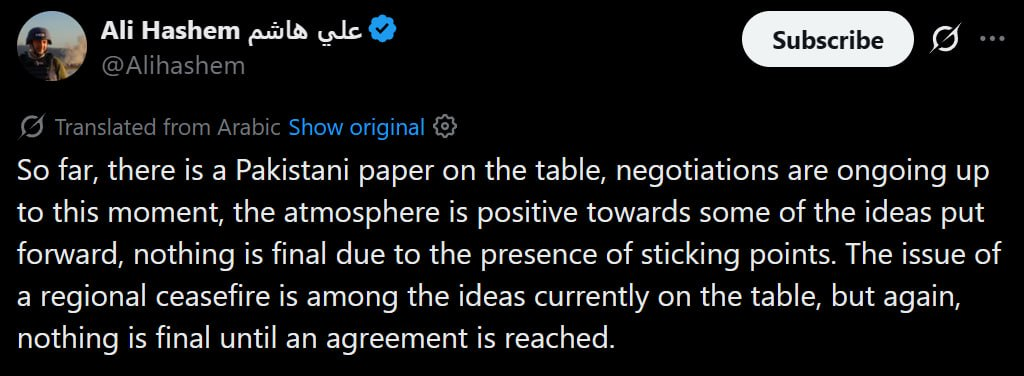
With just 90 minutes remaining, the world was holding its breath: “So far, there is Pakistani paper on the table, negotiations are ongoing up to this moment, the atmosphere is positive towards some of the ideas put forward, nothing is final due to the presence of sticking points. The issue of a regional ceasefire is among the ideas currently on the table, but again, nothing is final until an agreement is reached,’ reported Ali Hashem, senior Al Jazeera correspondent.
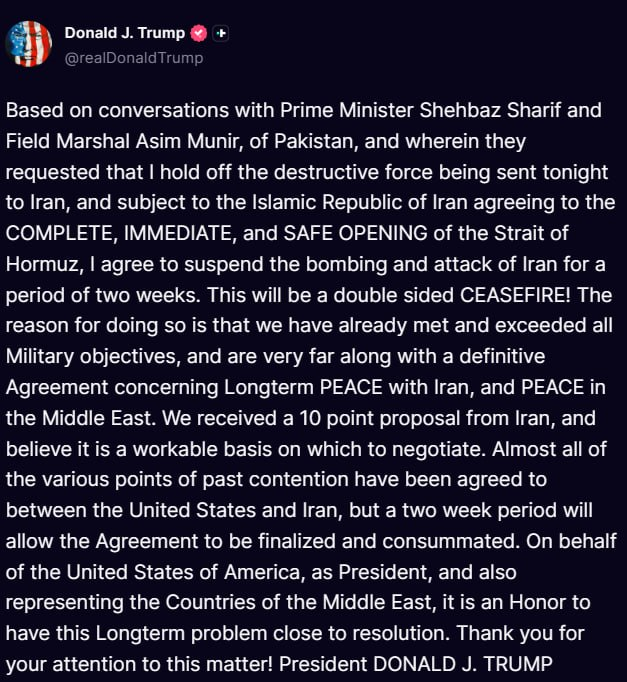
Soon after, Trump took to Truth Social to confirm that a ceasefire would take place once Iran had agreed to the complete, immediate, and safe opening of the Strait of Hormuz.
Main points of the ceasefire include a complete ceasefire in Lebanon, Israel, and the Islamic Resistance in Iraq, while Iran will exercise control over the Strait of Hormuz, charging tolls for ships passing through. Negotiations on Iran’s 10-point plan will begin in Islamabad on Friday, which would involve a non-aggression clause, lifting all sanctions against Iran, acceptance of continued Iranian uranium enrichment, and continued Iranian control over the state. US forces must also withdraw from the region and not contest regional security, and compensation to Iran, after the war has ended on all fronts.
Israel were denying initially that Lebanon were part of the ceasefire, according to various sources, despite the statements by Iran and Pakistan, such as Yaron Avraham of Israeli Channel 12 who said: “Israel does not like this deal – to put it mildly – Trump decides,” before attempting to say that Lebanon wasn’t part of the deal, while an Israeli security source told Israeli Channel 11: “We were surprised by Trump’s decision and received updates at the last minute after everything was decided.”
China intervened to help Iran accept Pakistan’s two-week ceasefire proposal, three Iranian officials informed the New York Times, stating China asked Iran to show flexibility and defuse tensions amid growing economic uncertainty caused by damages to Iranian infrastructure.
Iran’s Supreme National Council said that: “If the enemy’s surrender on the battlefield turns into a decisive political achievement in the negotiations, we will celebrate this great historic victory together, otherwise, we will fight side by side on the battlefield until all the demands of the Iranian nation are met – our hands are on the trigger, and as soon as the enemy makes the slightest mistake, it will be responded to with full force.”
Just as Israel’s Channel 12 was told by an American official that Iran would need to reopen the Strait of Hormuz for the two week ceasefire to begin, an announcement was made through Al Jazeera and Tasnim News that Iran had reopened the Strait.
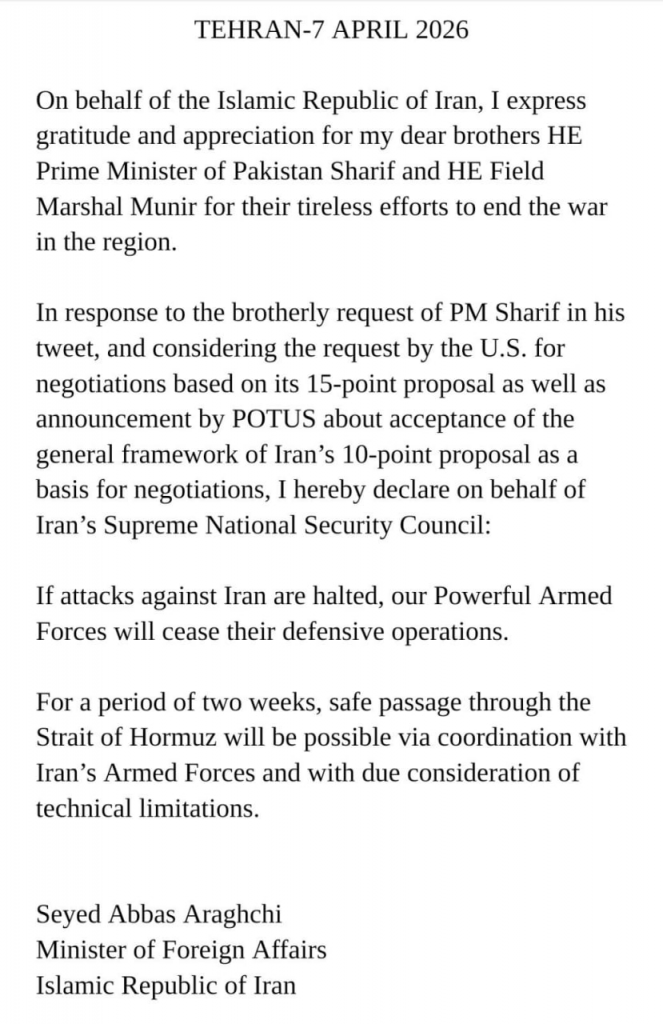
FM Araghchi released a statement saying: “For a period of two weeks, safe passage through the Strait of Hormuz will be possible via coordination with Iran’s Armed Forces due to consideration of technical limitations.”
A US official then told Al Jazeera that all military operations had been halted, the ceasefire is set to begin immediately, but it would take time for the orders to reach the individual units of the IRGC due to internet shortages, according to Axios.
Iran and Oman would collect fees for passage through the Strait of Hormuz in accordance with the two week ceasefire plan, according to AP, noting that Iran plans to use the funds for reconstruction, but its unclear what Oman would use their portion for.
Supreme Leader Mojtaba Khamenei officially ordered the IRGC missile units to stop firing, according to Iranian state media and Middle East Eye, noting again that it could take time for the orders to reach all positions.
Iran insisted that Lebanon be included in the ceasefire, a senior Israeli official told Israeli Channel 12, while Naya Iraq reported that the Islamic Resistance in Iraq had announced it would cooperate with the two week ceasefire and suspend all operations, although Israel’s Prime Minister’s office was still denying it in the early hours of the morning, and soon after an airstrike struck the Al-Qlailah area of southern Lebanon, targeting an ambulance, according to Al Jazeera.
Trump took to Truth Social again, this time saying: “A big day for World Peace! Iran wants it to happen, they’ve had enough. Likewise, so has everyone else! The United States of America will be helping with the traffic buildup in the Strait of Hormuz. There will be lots of positive action! Big money will be made. Iran can start the reconstruction process. We’ll be loading up with supplies of all kinds, and just ‘hangin’ around’ in order to make sure everything goes well. I feel confident that it will. Just like we are experiencing in the US, this could be the Golden Age of the Middle East!!!”
An absolutely livid Yair Lapid, the Israeli Opposition Leader, said: “There has never been such a political disaster in our entire history. Israel wasn’t even at the table when decisions concerning the very core of our national security were made. The military did everything asked of it, the public showed incredible resilience, but Netanyahu failed politically, failed strategically, and did not meet a single one of the goals he himself set. It will take us years to repair the diplomatic and strategic damage Netanyahu caused due to arrogance, negligence, and a lack of strategic planning. More details later today.”
First round of negotiations are expected to take place on Friday on Islamabad, with representatives from Iran meeting with Vice President JD Vance, Special Envoy Steve Witkoff and Jared Kushner, which would mark the first in-person talks between the two sides since the conflict began, reported Axios.
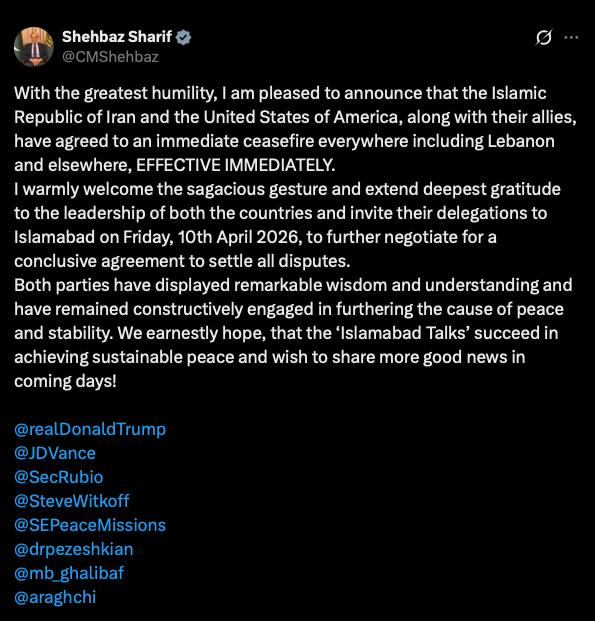
Pakistani Prime Minister Sharif announced an immediate ceasefire had been confirmed, taking effect across all fronts including Lebanon, welcoming the agreement as a significant step towards de-escalation, praising both sides for what was described as a ‘sagacious’ and constructive approach to ending hostilities.
Trump described the ceasefire agreement as a comprehensive victory for the US, promising that the issue of Iran’s nuclear program will be addressed completely, reported the AP, who also confirmed that Trump believed China to have pushed Iran to negotiate, and when asked if he would threaten again to hit Iran’s power plants if the deal fell through, Trump said: “You’re going to have to wait and see.”
Israel’s Prime Minister’s Office said soon after that it supported US President Trump’s decision to suspend the attacks on Iran for two weeks, on the condition that Iran immediately reopens the Strait of Hormuz and halts all attacks on the US, Israel, and regional countries, reported Kan News, noting the statement added that Israel backed US efforts to ensure Iran no longer poses nuclear, missile, or ‘terrorist’ threats to the US and all other countries in the region, concluding by saying that the two week ceasefire didn’t include Lebanon.
Australia welcomed the two week ceasefire between the US, Israel and Iran to negotiate a resolution in the Middle East, citing efforts to reopen the Strait of Hormuz and protect civilian life.
VP JD Vance may have been involved behind the scenes along with China to help push a ceasefire deal, reported the AP, stating that Vance had looped in Chinese officials in an effort to get Iran on board.
Egypt issued a statement welcoming the ceasefire, calling it a key step toward de-escalation, regional stability, and the protection of civilian life, stating the pause offers a critical opportunity for diplomacy and urged full adherence to the ceasefire and respect for international navigation.
Oman welcomed the ceasefire and praised Pakistan’s efforts alongside other parties calling for an end to the war, stressing the need to intensify efforts towards a permanent end to hostilities and a lasting resolution to the crisis.
UK Prime Minister Sir Kier Starmer is traveling to the Gulf for talks with allies on reopening the Strait of Hormuz now a ceasefire had been confirmed, saying that he welcomes the ceasefire and will work with partners to sustain it and turn it into a lasting agreement, while also meeting British forces in the region.
Secretary-General António Guterres welcomed the two-week US-Iran ceasefire, urging all sides to respect international law and the deal to advance lasting peace, stressing the urgent need to protect civilians, while thanking Pakistan and other mediators, and said his envoy Jean Arnault is in the region to support the peace efforts.